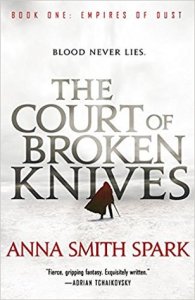
 The Court of Broken Knives by Anna Smith Spark
Genre: Fantasy — Grimdark
Series: Empire of Dust #1
Publisher: Orbit (August 15, 2017)
Author Information: Website | Twitter
Length: 473 pages
My Rating: 2.5 stars
The Court of Broken Knives is a novel which has taken me on a long journey. Not only alongside the characters which Anna Smith Spark has created, though that is true, but also my own journey of self-discovery, as I’ve found myself on a quest to reconsider my reading preferences, modify my bookish desires. This causing my review to take months to finish, as I returned time and again to the book to do lengthy rereads, attempting to focus my mind, come to grips with the conflicting emotions which this novel had produced within me.
To be fair, when I finished The Court of Broken Knives back in November of 2017 I viewed it as yet another in a growing line of great grimdark, one I enjoyed so much that my rating was a solid 4 stars and included a spot on my Best Reads of 2017!. Anna Smith Spark’s bringing her beautiful writing style to the genre, adding her elegant, lyrical, and unique voice to a genre previously known mainly for its dark, pessimistic, violent, and decidedly masculine outlook on life. But under my initial euphoria was a growing seed of discord, one I will explain further after we set the stage.
The Court of Broken Knives takes place mainly in the city of Sorlost in the Sekemleth Empire. This legendary rich and powerful metropolis mired in decadent decay, moving steadily toward ultimate destruction unless something occurs to halt the downward spiral. Rising to the challenge. Lord Orhan, a nobleman and important councilor of the Empire, formulates an elaborate coup to destroy the Emperor and most of the ruling elite, thereby allowing him and his co-conspirators to take control and guide the Empire back to its former power and glory.
One of the keys to Orhan’s plans is a group of foreign mercenaries who quickly infiltrate the city; their leader an older, experienced warrior by the name of Tobias. This guy is a practical, ordinary man who isn’t the most gifted merc but is determined, quick witted, and practical to a fault. Those he leads tending to follow along in the same vein as their commander; all except for young Marith, who begins as a rather mysterious sort and slowly evolves into a fairly murderous individual with a horrible habit, terrible secrets, and a dark destiny. Tobias’ plans complicated and jeopardized by having to deal with Marith’s growing issues while still attempting to be the Orhan’s weapon to mete out death among Sorlost’s elite.
Not initially caught up in these events, there is also Thalia, high priestess of the god of life and death. This god not for the faint of heart, requiring regular human sacrifices (preferably small children) which Thalia is forced to personally perform. The constant killing taking its toil on her mental state. What makes it even worse is that she knows her life will remain this way until a new high priestess arises and kills her, just like she did to her predecessor. This stress, depression, and apprehension causing Thalia to seek escape from her prison, even if that means tying herself to an even worse person/cause!
Without a doubt, all this sounds like grimdark fantasy at its best, and the classic staples of the genre are indeed present in abundant supply. There are dark, jaded characters everywhere. Plot twists abound. Byzantine scheming and political machinations rule the day. Dark humor, bloody action, unhealthy love, diabolical betrayal, and cringeworthy deceit are the norm. Hell, in Marith, we even have a tortured, psychopathic character who would give anyone from George R.R. Martin’s A Song of Ice and Fire nightmares and make Mark Lawrence’s Jorg Ancrath take pause. But therein also lies the seeds of my problem with The Court of Broken Knives: it is horribly, terribly, completely, extremely, unbearable dark and grim.
A weird criticism I realize, especially coming from me: the grimdark convert who became an adoring fan after reading such classics as Lawrence’s Prince of Thorns, Fletcher’s Beyond Redemption, Polansky’s Low Town, and Abercrombie’s The Blade Itself. Be that as it may, after months of reflection and numerous rereads of certain sections of the narrative, I finally came to the conclusion that what bothered me about this novel was the fact it had taken the grimdark genre to its ultimate apex, serving up a world and story so grim, so dark, and so damn depressing that even I couldn’t really appreciate it. Let me try to explain why I say that.
For me personally, I prefer my stories to have contrasting characters, dueling ideologies, competing champions to keep things fresh and exciting. If the darkness is too thick, too grim, too all encompassing, I get bored. I mean, if all my choices are basically the same, why do I care if a certain character lives or dies, triumphs or fails. I don’t. And in The Court of Broken Knives, I really felt like there was no one to hold onto while all the goodness in the world died a painful death. There was no hero or anti-hero to pull for until he/she is cast down. No villain who has noble motives even if his/her means are vile. Nope, here the darkness is unrelenting; the characters completely unsympathetic; and the plot a choice between what shade of black I would prefer.
The prime example of all this are the main four characters of the story. Let’s take a closer look at them, see the choices of black.
First, there is Lord Orhan; a man who initially appears to be a misguided idealist, someone who dreams of a change for the better. Sure, he is willing to kill lots and lots of people to get the change he believes is needed, but he only wants to restore his city, his nation to greatness. Brings to mind Hitler, but I can feel it. Once you get to know him though he is pretty far removed from any semblance of an idealist. Instead, Orhan is revealed as a dissatisfied man, married to a woman he does not love, yearning after a man he probably should not trust, living a total lie for reasons he doesn’t even totally believe in anymore, and hating the mantle of would be savior he has assumed. Totally depressing.
Then we have Tobias, who is probably the closest thing to a decent human in the whole sorry bunch. Problem being he is a glorified assassin, determined to kill people for gold. His conscious is locked up at home somewhere, and he is willing to deal with anyone necessary to get the job done. A good quality for a mercenary, necessary even, but one which doesn’t cause him to be terribly sympathetic. The fact he is hooked up with Marith merely makes his faults even more pronounced and off-putting.
Next up is the mysterious Marith. Some have described him as pitable, but I never saw him that way. Where Jorg Ancrath of Lawrence’s The Broken Empire had some slim explanation for his sociopathic leanings, Marith is a despicable being in the present, past, and on into the future from the look of things. I can concede he has personal issues from his past, haunting tragedies to bear around, and a terrible addiction to deal with, but none of it made me pity him in the least. He is a sociopathic nightmare, wrapping his loathsome actions inside pathetic excuses while gorging himself on more and more extreme doses of violence and killing in the name of an ancient god. Not sympathetic at all for me.
Lastly, there is the deeply scarred Thalia, whose role sacrificing children to a blood-thirsty god has left her mentally handicapped, extremely warped, and generally unprepared for the real world outside her blood soaked temple halls. Her choices in this narrative leaving me wondering if she has the smallest ounce of wisdom anywhere inside her body since she becomes fascinated by a man who promises to do nothing but take her down a road even more bloody than her previous one. A choice which still strikes me as odd considering her desire to flee her former life.
Hopefully, you can now see that these characters are all shades of black, not grey, certainly not white, but dark black. This consequentially means their individual stories are dark and grim, as you would expect from deeply flawed, horribly jaded, and near inhuman (at least in the case of one person) characters. And compounding this problem is that there are no characters of a different shade (grey or white) to add contrasting points of view to the plot, insert a bit of levity, or bring a bit of light to the curtain of darkness which shrouds everything. Without those “lighter” characters The Court of Broken Knives remains bleak, gloomy, and destructive from its opening page to its last, immersing a reader into the depths of total grimness.
It’s a gridmark. It’s suppose to be dark, gory, and depressing. Get over it already. I hear some of you mumbling.
True. It is very possible my criticism of this novel is merely my own personal foible come to light, showcasing my growing weariness of unrelenting grimdark. And, yes, I can acknowledge that perhaps at another time, another place in my reading journey, I might have been drawn into Anna Smith Spark’s tale of darkness, embraced it, and loved every moment of it. But right now, I’m not interested in that type of tale. Instead, The Court of Broken Knives depressed me, reinforced my growing feelings that I don’t want to visit a world this dark, this horrifyingly grim, inhabited by such deeply flawed people anymore in the near future. I really need some light to fight against the darkness, some optimism to dilute the pessimism, some good to struggle against the bad, a few decent people to make me care about the struggle I’m reading about.
That leads directly into why my rating went from 4 stars in November of 2017 to 2.5 stars in May 2, 2018. Simply put, I finally realized why I initially gave The Court of Broken Knives those 4 star rating: Anna Smith Sparks writing style; her beautiful words and phrases nearly able to overcome the suffocating darkness of the story itself, wash away the bitter taste in my mouth, and convince me I adored this grimmest of grimdarks. But the truth, hard as it was for me to accept, is that I simply don’t love this novel, don’t have any particular fondness for any of these characters, and never was caught up in their stories. Certainly, it is an okay read, especially if you enjoy grimdark at its most extreme, but not much better than that, hence the 2.5 stars.
Does all this mean you shouldn’t read the book? I can’t answer that. It is all based on your reading preferences. Michael Fletcher, author of Beyond Redemption, has dubbed Anna Smith Spark “the queen of grim dark fantasy”; a title which is well deserved and very accurate. And if you wish to immerse yourself in the complete darkness, cynical depression, and unswerving grimness, then this is a book which will not disappoint, because it truly is a grimdark for the ages. However, if like me, you are a bit tired of pervasive bleakness, amoral violence, and pessimistic nihilism, then this might not be for you. It is your choice.
I received this book from the author in exchange for a fair and honest review. I’d like to thank her for allowing me to receive this review copy and inform everyone that the review you have read is my opinion alone.
Purchase the book at Amazon.




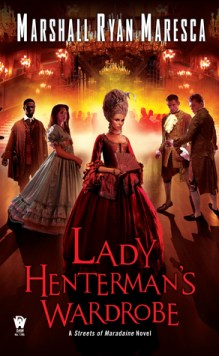 Lady Henterman’s Wardrobe by


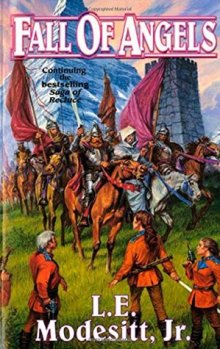 Fall of Angels by L. E. Modesitt, Jr.
















 10.
10.  at Amazon
  9.
9.  at Amazon
 8.
8.  at Amazon
 7.
7.  at Amazon
 6.
6.  at Amazon
 5.
5.  at Amazon
 4.
4.  at Amazon
 3.
3.  at Amazon
 2.
2.  1.
1. 















 bookwraiths.com