Wounded Warrior Fizzled

16109249
My rating is 1 out of 5 stars.

A Vietnam vet lives alone in the country. He seems normal enough, but he has a secret you see: there is a door in his home that opens onto another world.

This portal to the other place is his most guarded secret understand.

Our Nam survivor once had numerous life-threatening illnesses. The kind that would eat away at you from the inside out, leaving a man a drooling shell of himself. He had beaten the odds and survived though, just like he had done in Nam. Except this time his survival was more than luck or caution, but the arrangement he made with those he had discovered on the other side of the door.

His part of their bargain is simple really: periodically someone must pass through the door into the other world.

Just a small thing. Not even hard to accomplish.

There are always those people confused about their place in this world, desperately seeking something magical. Those people respond to the advertisements he runs. Usually, they seem to be war veterans like him except from Iraq or Afghanistan, and many times they are addicted to the fantastical computer games indulged in by the younger generation. Every one of them eager to leave this dreary “normalcy” of the modern world for something fantastical.It is these people who find their way to his home and voluntarily go through the door, never to return again.

Who is he to say they meet a horrid end?

How would he even know.

But what he does know is that his latest victi . . . volunteer has arrived, eager to begin his journey, and once he steps through the doorway, the illness will be kept at bay for a while longer. For that miracle, a few strangers disappearing forever is not too high a price to pay.

Wouldn’t you agree?

Sounded like a pretty good story to me. At least, that is what I thought when I downloaded it. In fact, I got a bit psyched about reading it, hoping for a diamond in the rough discovery. When I actually tried to read this e-book however, I only got through the first couple chapters before I deleted it from my e-reader. The writing was atrocious. The plot was high on potential and low on delivery. A good story idea soon became banished to the refuse heap of my life.

Oh well. You win some you lose some I guess

Posted in Fantasy | Tagged , , , , , , , , , , , | Leave a comment

From Man to Man Great Introduction to New Series

17703621
My rating is 3 out of 5 stars.

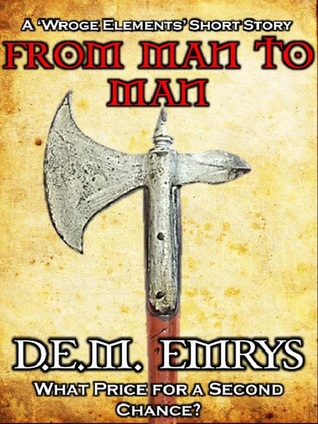
When I sampled this short story, I was in the process of reading David Gemmell’s Troy series, so that type of epic fantasy writing was what I was accustom to. Imagine my surprise when I found “From Man to Man” as a free download and discovered an indie author writing a fantasy tale with that same sort of realistic action and characters. I was absolutely amazed and excited, especially since this was just a teaser for his upcoming series Wroge Elements.

The story here centers on Draven Reinhardt: an accomplished warrior, former mercenary (At least that was my assumption based on clues) and loving husband/father. Draven is attempting to abandon his bloodletting ways and settle down as an average, salt of the earth villager. Naturally, our former mercenary struggles to fit in, let alone hold down a job. I mean, he is great at cutting down trees with his axe, even though he swings it more like he is cleaving necks than branches, but how many trees does a small village really need cut?

Not enough for Draven to take care of his family unfortunately. So when a chance to make a little extra coin comes his way, our merc turned villager finds himself in a horrible situation. For on one hand, he has made a promise to his wife that he will never go back to his old ways, but on the other, he knows he will never be able to survive as a normal villager, because his best work skill is killing other men. That is the moral dilemma examined here.

Draven’s decision and its consequences progress on from there, and Mr. Emrys spins a very entertaining yarn out of it, twisting our warrior villager this way and that as he tries to be true to his promise but also take care of his family. Added to this a reader is presented with a realistic setting (though the world building is very short) as well as one action scene at the end of the tale, where Mr. Emrys excels at presenting a rousing and intense struggle without overdoing the details. So all in all, this is an entertaining short story as well as a great primer for Emrys’ Wroge Elements series.

Highly recommended!

Posted in Fantasy | Tagged , , , , , , , , , , , | Leave a comment

THE GATEWAY (HARBINGER OF DOOM) by GLENN G. THATER

5712707My rating is 2 out of 5 stars.

This Beowulf-inspired tale begins near the city of Dor Eotrus, which lays in a northern land that is more than a little Viking-esque. These northerners are fiercely independent, believing their more “civilized” neighbors are weak and pride themselves on their prowess in battle. So when a strange mist begins rolling outward from a mysterious, dark circle in the nearby forest, the old king, his fast friends and their trusted, war veterans sally forth to investigate the bloodcurdling shrieks which are emanating from it every night.

No matter these heroes confidence in their battle prowess however, what they find within the watery enbrace of the night is more than they were expecting. Indeed, the horrors which await them have not been seen by men for many ages of the world, and when it’s presence is made known, can even the king and his friends vaulted might with steel and magic save the world from its dark embrace?

Who can tell, because the mist covers all, hiding the fate of the king’s party from his people.

As the king fails to return, those left behind in Dor Eotrus worry as to his party’s fate. They do not realize yet what lies concealed by the mist, and even though they prepare for the worst, they each cling to the faint hope that perhaps their beloved king and his warriors still lie within the misty shroud, lost or fighting the evil that must reside therein. And it is this thought which spures the princes to sally forth to their father’s rescue.

Naturally, this is when our mysterious Beowulf-like warrior named Theta appears.

Lord Theta, and his squire Dolan, ride into Dor Eotrus as if on cue. Theta is a mighty man of war with ancient armor, weapons and wisdom encompsing both forbidden knowledge and magic. Dolan is an average warrior, but one who has followed his lord through many strange conflicts and seen many mysterious things, which have made him greater than he otherwise would have been.

Upon arrival at the mist besieged city, these two strangers are immediately taken into the confidence of the king’s son and his remaining advisors without any questions or doubts. Once ensconced there, Theta proves himself to be the strong and silent type, and though it is obvious that he knows what his new friends are about to face, he never warns them of their danger. Thus, the group heads into the mist and unto the dark circle in the woods with no one but Theta and perhaps Dolan understanding what is about to tranpire.

The story that follows is a good, old-fashioned monster bash, as our group of heroes follow the enigmatic Lord Theta into the magical vortex powering the mist. Swords are blooded, skulls are bashed, and Lord Theta never has to say much of anything.

This e-book (novella) is okay at best. However, it has significant problems.

One, the author spends chapters and chapters in the beginning updating a reader on the history of the land and the buildings in Dor Eotrus; none of which is at all relevant to the story. Two, once the true plot begins to take shape, it just sputters out toward the end. Boom! Lord Theta kills a bunch of monsters, story is over, and we are ready for the sequels.

So be forewarned!

Posted in Fantasy | Tagged , , , , , , , , , , | 2 Comments

Black God’s War Is Worthy

8844576
My rating is 3 out of 5 stars.

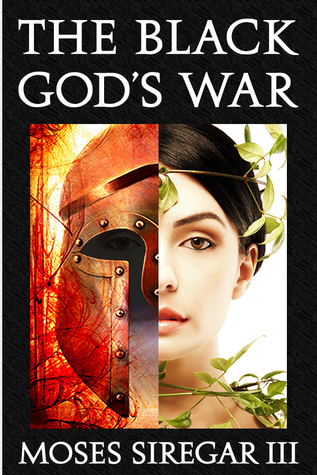
This novella is a great beginning to Mr. Siregar’s career. The Black God’s War has it all: interesting characters, mysterious gods, warring kingdoms, and twisting and turning plots. For those reasons alone, you should pick this book up and give it a try.

For me personally, my favorite parts of the novella resolved around Rezzia and her pantheon of gods, especially Lucia’s haunting by the Rezzia God of the Underworld. This plotline caught my attention from the first pages and held it throughout the rest of the work.

The other major conflict in this book is Rezzia and Pawelon’s eternal war with one another. Two, opposing cultures clashing together for generations at a mighty fortress. One nation bent on the annihilation of the other. While Mr. Siregar spends a great deal of novella presenting this conflict, the “war” serves more as a canvas upon which he can sketch the main characters personal conflicts, rather than a earth shaking struggle such as Lord of the Rings, so the battles before this Pawelon fortress never rise to the gripping drama of Tolkien’s Helms Deep. I personally believe the major problem here was that a reader is told the two nations hate one another, but you never understand why.

The only other complaints I had with this novella were that Pawelon magic was not explained sufficiently, and that the ending was too neat and tidy a wrap up of all problems. I personally hate plots or character conflicts left danging, but you can’t fix it all in two or three pages; life just doesn’t work out that neatly.

While I only gave this book a 3 star rating, I want to be clear that I enjoyed it. As is pretty evident by my ratings, I am stingy about giving 4-5 star ratings, so a 3 star rating is not a statement that a book is to be avoided. On the contrary, I would encourage people to read The Black God’s War.

Posted in Fantasy | Tagged , , , , , , , | 2 Comments

ROMULUS BUCKLE & THE CITY OF THE FOUNDERS

17046614
Romulus Buckle & the City of the Founders         by Richard Ellis Preston, Jr.

Genre: Steampunk

Series: Chronicles of the Pneumatic Zeppelin #1

Publisher: 47North (July 2, 2013)

Author Information: Website | Twitter

Length: 446 pages

My Rating: 4 out of 5 stars.

Zeppelins!

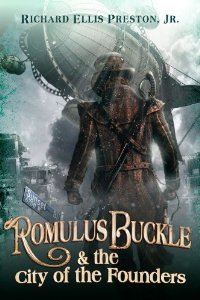
The image of those huge, silvery-skinned dirigibles drifting above the earth with a cloud-filled sky as a backdrop has always captured my imagination. Honestly, I’m not ashamed to say I have purchased several books just because they had a zeppelin on the cover: Michael Moorcock’s The War Lord of the Air being one of them. So, when I ran upon Romulus Buckle & the City of the Founders, I knew I had to read this novel.

From the first sentence, Mr. Preston gave me what I had always longed for in a zeppelin story: an adventure where the dirigible is the star of the show. Now, do not misunderstand, there are many interesting characters, suspenseful plot lines, and intriguing historical tidbits in this novel, but the Pneumatic Zeppelin absolutely steals the show in my opinion.

Our steam powered lady drifts across the skies of this steampunk world in all her glory, capturing one’s attention in the same manner that the Starship Enterprise does in Star Trek. And as a reader learns how she is built, how she is flown, how her captain and crew adore her, and how she fights, the Pneumatic Zeppelin blazes brighter than a hydrogen balloon on fire!

And like her spacefaring counterpart the Enterprise, this mighty ship also has a man who cherishes her above all mortal caresses; this man being one Romulus Buckle, who is cut from the same swashbuckling cloth as one James Tiberius Kirk. Indeed, from the first page, a reader understands that ”Romulus Buckle (i)s an airman, a zeppelin pilot, to be exact, or to be less exact, in the local slang, a gasbag gremlin, a dirigible driver, a balloon goose, an air dog, or whatever moniker any lazybrat might cook up in his gin-stewed cerebellum.” He is young, dashing, handy with a saber, and without a doubt married to the lady of his dreams: the Pneumatic Zeppelin, and as the story begins, he is a man on a life-and-death mission with his trusty crew in tow.

For in this post-apocalyptic world, the men of the Snow World – the old California – are divided into clans, fight never-ending skirmishes against each other, and attempt to live their short lives to the utmost before a quick death descends upon them. But now, something unheard of has occurred, as the “fogsuckers,” or the Founders if you will, have kidnaped Balthazar Crankshaft and several other clan leaders from a peace conference. This upsets the delicate balance of power in the Palisades, leaves all the clans feeling vulnerable, and has brought the Snow World unto the brink of all out war.

With the Founders not explaining their actions, the other clans are left to assume that their mysterious neighbors intend to finish what they began decades before: bring to heel all the clans around them and thereby fulfill the original “Founders” ancient desire to reshape human civilization.

But wait!

Before the “fogsuckers” can unleash their dreadful plans, Romulus and the Pneumatic Zeppelin are dispatched to set things right. They will attempt the impossible: pass through the walls of poisonous gas that surrounds the Founder’s city of old Los Angeles, breach the Founders’ legendary defenses, and snatch Balthazar out from under their very noses. The whole of the Crankshaft Clan believes the Pneumatic Zeppelin can accomplish this; the zeppelin’s crew is ready to lay down their lives for this task; and Romulus Buckle is willing to sacrifice everyone – including his own dearly loved airship – if that is what it takes to rescue Balthazar!

The adventure that follows is well-worth a reader’s time. There are “blackbang powder” musket battles, sword fights, dirigible combat, not to mention a fascinating crew (whose personalities and camaraderie remind you of Jim’s spacefaring group) as well as all the usual elements of the steampunk genre. Without a doubt, Romulus Buckle and the City of the Founders” is an exciting ride, yet as I said, the zeppelin is the star here, whether the author intended it or not. For as Romulus Buckle himself points out: “The sky (i)s the place to be.”

Yes, it is Romulus. Can I go ahead and sign up for the next novel right now?

I received this book from 47North and Netgalley in exchange for a fair and honest review. I’d like to thank Netgalley for allowing me to receive this review copy and inform everyone that the review you have read is my opinion alone.

Purchase the book at Amazon.

Posted in 4 Stars, Post-apocalyptic, Science Fiction, Steampunk | Tagged , , , , , , , , , , | 3 Comments

Book Review: Darkover Landfall, Marion Zimmer Bradley (1972)

Joachim always delights in his ruminations on classic science fiction novels. Anyone interested in these books MUST follow him now.

Joachim Boaz's avatarScience Fiction and Other Suspect Ruminations

(Jack Gaughan’s cover for the 1972 edition)

3/5 (Average)

Marion Zimmer Bradley (1930-1999), most famous for her Arthurian fantasy novel Mists of Avalon (1983) from late in her career, published countless SF works starting in the late 1940s.  Her first novel The Planet Savers (1958) introduced readers to the massive and complex Darkover sequence of works — by far her most famous and iconic contribution to SF.

Darkover Landfall (1972) is a somewhat routine adventure (with a good dose of social commentary) which, according to internal chronology, is the beginning of the vast Darkover series.  Although I cannot speak for the rest of the sequence as this is the first of Bradley’s novels I’ve read, I found Darkover Landfall a problematic and

View original post 803 more words

Posted in Science Fiction | Tagged , , , , , | Leave a comment

What Do You Have Friends For?

More Good Info To Boost E-book Sales

ebooksinternational's avatarSavvy Writers & e-Books online

.

.
How friends and family can help to improve your Amazon Ranking will be a reminder today, short before the holiday season starts.  They indeed can help you so much – they even don’t need to buy the book (again). Amazon can give a great book a big boost to “be discovered”.  These little features take only a few seconds, but can make a big difference in your Amazon ranking – and subsequently in the success of your book.
.
Ask all your acquaintances, friends, family to:.

  • Write a REVIEW of your book.
    Even if the book already has lots of reviews already. As more reviews as better for the author and as more potential buyers can see the popularity of the work. Amazon rules are against family members’ reviews.  So ask only the ones with a different name/address for a review. They need an Amazon account and at…

View original post 479 more words

Posted in Writer Resources | Tagged , , , , , | Leave a comment

46 Top Websites to Promote Your Book for FREE

Great article about promoting books for free. Check it out.

ebooksinternational's avatarSavvy Writers & e-Books online

.
Added June 23, 2013:

Dear Reader:  This list of websites, which we compiled in March 2012, grew in the meantime to almost 100.  Please visit our two new blog posts with even more possibilities to announce your work for free:

http://savvybookwriters.wordpress.com/2012/11/03/50-web-links-to-let-your-book-go-viral/

http://savvybookwriters.wordpress.com/2012/11/04/part-2-45-more-websites-to-promote-your-book/

All three blog posts are officially copyright registered.  To link to our blog posts, and let your own readers know about these websites, please use the RE-BLOGGING link on top of this page.  Thanks!  Please learn about re-blogging here:
http://savvybookwriters.wordpress.com/2013/06/01/re-blogging-vs-copyright-infringement/

.

Original Article from March 11, 2012:

1. Goodreads
Use your free membership to promote yourself and your books. Reviews are essential and reviews on Goodreads site help your book to really stand out to millions of visitors.

2. Wattpad
Wattpad has experienced explosive growth since its inception and has become the world’s most popular destination to publish and read e-books. Wattpad delivers billions of…

View original post 765 more words

Posted in Writer Resources | Tagged , , , | 1 Comment

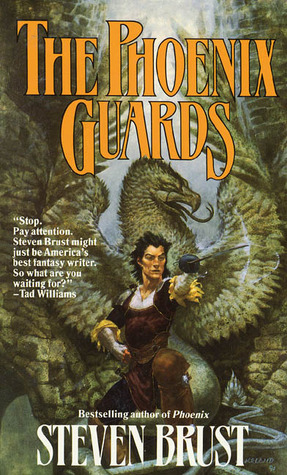
Brust’s Phoenix Guard Too Wordy

133460
My rating is 2 out of 5 stars.

Steven Brust is an unabashed fan of Alexander Dumas, and The Phoenix Guards is his attempt to both emulate and exceed the swashbuckling master of such classics as The Man in the Iron Mask and Count of Monte Cristo. And if one begins this work understanding that this tale is a simulacrum of The Three Musketeers, then you shall have a far better chance of enjoying the book.

Like Dumas, Brust opens this work by stating that it is based upon a manuscript by another author. Here that book is a “notebook” created by one Paarfi of Roundwood; a historian who has done extensive research concerning the events preceding the fall of the Dragaeran Empire and the Interregnum, which followed. Unfortunately, for Paarfi, his work titled Toward Beginning a Survey of Some Events Contributing To The Fall of the Empire was rejected for publication, and so, in an effort to inform people of the important events of this time and put to use his extensive research, he has developed this story we are about to enjoy.

Paarfi thereafter spins a yarn centered on one Khaavren (D’Artagnan), an impoverished country noble, and though the point of view in the story does shift occasionally, the majority of the events in the story are told through his eyes. In any event, our young swashbuckler is a young, naive Dragaera, and though he has – as you would expect – a sword which he is “tolerably well-acquainted with,” he also has lots to learn about the world. Thus, he finds himself pointed toward Dragaera City to make a name for himself.

Quite early on into Khaavren’s journey, he stumbles into a Lyorn and Dzur, who befriend him; their names are Aerich (Athos) and Tazendra(a female Aramis.)

Now, please understand that the designation of which house these two – and everyone else -belong to is very important in this story, because Dragaera is basically a medieval, feudal society, whose people are members of one of seventeen Houses, or genetic lineages. Each house has its own physical and personality traits, which identify them alone, and so by knowing which house a character is from, a person can instantly make assumptions about said person, and how they will generally behave in almost any given situation.

Naturally, Aerich and Tazendra begin chatting with Khaavren, inform him that they are also lacking in a proper noble income to keep them up and are seeking some redress for this divine prank. To be helpful, Khaavren shares his plan to join the Phoenix Guards, the new Emperor’s elite personal troops, and his new friends decide to accompany him on his mission.

When the three arrive in Dragaera City, they meet Pel(Porthos), a Yendi, who is already a member of the guard. Pel helps the trio sign up and even buys their equipment for them. This kind act plus their instant comradery causes Pel to join the trio, and the four musketeers . . . I mean, Phoenix Guards are born. Together the foursome begin swashbuckling their way through adventure after adventure, while they attempt to find their way in the world, uphold their personal honor, fight sword duels, and always cut dashing figures.

Now, this tale that Brust gifts us with is a fine tribute to Dumas, but it is also difficult to digest. There are moments where it is very enjoyable, but there are many, many times it is sheer torture to read. The main problem is, without a doubt, the author’s attempt to replicate the formal and ornate style of Dumas, and while Brust succeeds beyond belief in accomplishing this, it might have been better if he had not, because soon the wordy exchanges between the characters become more annoying than pleasurable.

Would you like me to give you an example of this?

Absolute, sir.

Then I will most definitely do so.

Please do so right this instance.

I most certainly will, and let me begin.

It seems that every simple facet of life becomes an intricate, verbal dance for the people in this book. In one chapter, we have our four friends departing the city, but Tazendra seems ill at ease, so the following conversation commences.

Khaavren said, “My good Tazendra, it seems to me that you are unusually silent.”
“Well, I am,” she said.
“Then tell me, for I am curious, what accounts for this uncharacteristic quietude?”
“I reflect,” pronounced Tazendra.
“Ah! You reflect. Pel, Tazendra has been reflecting.”
“That is right,” said Pel. “And well she should.”
“And yet,” said Khaavren, addressing himself once more to the Dzurlord, “I should like to learn upon what you reflect.”
“Just this,” said Tazendra. “We are leaving the city.”
“The Horse!” said Khaavren. “I think we are.”
“I was wondering-“
“But you just said you were reflecting.”
“Oh, I was, I assure you. Only-”
“Yes?”
“My reflections transformed themselves into wonderings.”
“Well,” said Khaavren, “mine have been known to do the same.”
“It has happened to me,” admitted Pel.
“I never wonder,” said Aerich.
“But then,” resumed Khaavren, “you say your reflections gave over to wonderings on some subject about which you had questions?”
“Yes,” said Tazendra, “you have hit it exactly.”
“And what did you wonder?”
“Just this: we are leaving the city-”
“You had already reached the point while you were merely reflecting.”

The conversation progresses from there as the four companions debate why they are leaving the city, what they are intending to do, and how they intend to do it. All this done in the most convoluted manner imaginable.

If this was an isolated event, one could overlook it. However, every page contains long, very intricately constructed sentences, where everyone in the novel is determined to be overly formal, overly polite and speak for paragraphs without actually ever getting to the point. When I suggest that the most routine encounter turns into a three page circuitous conversation, I wish I was exaggerating

Even when things become heated between our heroes and others, and it is obvious that swords will be drawn and blood shall be shed, the character’s speak in a byzantine manner.

“‘It is not a word,’ said Pel, tossing his cloak over his shoulder so that the elegant hilt of his blade was visible, ‘that pleases my ears.’
‘Well,’ said the lady who had spoken first, ‘I confess that your ears are of only a little concern to me.’
‘But,’ said Pel, bowing politely, ‘your tongue is of great concern to me.’
‘For my part,’ said Khaavren, ‘I am concerned with her feet.’
‘How,’ said Aerich, who stood between Pel and Khaavren. ‘Her feet?’
‘Indeed. For if she will use them to move from these cramped quarters, well, I will do her the honor of showing her what my arm can do.'”

Now, many of you may find that last citation witty, if not laugh out loud funny, and it is humorous. But when it is placed into a book, where every page is overblown meandering, you do not even realize the joke is there; it fades into the gray lifelessness that your mind has become from trying to comprehend the unending obtuseness of everything.

And when the characters themselves are not distracting enough, Brust draws in our historian Paarfi, who is written in an annoying, pompous voice. He makes an appearance every chapter or so, interjecting confusing references to Dragaeran people or events that are suppose to aid a reader’s understanding of the story, but merely serves to add length to the book and confuse one even more than the rambling dialogue.

An example of this is one chapter, where it begins by Paarfi rambling on about “. . . a certain play, which was written by the master playwright Villsni of Cobbletown, which is called The Return of Duke Highwater.” Our narrator goes on to explain what this play was about and compare it to the current story, where a major plot point has never reared its head but will do so now.

I need to know this why?

Wouldn’t it have worked just as well to introduce the plot point instead of giving me a review of a fictitious play and compare the two?

But this is merely one example of Paarfi’s interruptions into the flow of the story. At other points, Paarfi interjects even more obscure things: such as the history of Dragaeran fortifications. There he explains to the edge of the seat reader that: “The creation for the first time of forts and fortresses (the distinction, certain comments by the Lord of Snails notwithstanding, having nothing whatsoever to do with the presence of breastworks, nor the size of buttresses).”

And it goes on and on.

Even the ending, where Brust does his normal tying up of all the loose plot ends, is merely a reflection of the Dumas work, to which this is a tribute. If you are at all familiar with the tale of the musketeers, you have already foreseen how our four friends tale will end, which means there is absolutely no suspense in the novel.

No doubt, you can tell by this point that I did not enjoy my re-read of this book. This is the third time I’ve had the pleasure to purview this novel, and each time it becomes less and less appealing. And while I realize Brust’s writing style is mimicking Dumas’ original, it just does not excuse the problems with the flow of the story.

I do realize many of you already have a desire to read this book, and so you would like me to list the positive aspects of The Phoenix Guard. I will now attempt to do so as simply and succinctly as possible.

PROS
1) This is set in the Dragaeran Empire of Brust’s Vlad Taltos series but a thousand years before Vlad’s birth. If you enjoy those novels and wish to learn more about the “history” of the Dragaera, then The Phoenix Guards will present you with some of that lore. Also, this history will be coming from Dragaeran characters, not an Easterner, and so it should not be tainted by Vlad’s preconceived like or dislike of the Dragaera.

2) The writing style. Even though I criticized its overblown intricacy, it cannot be denied that Brust puts on a mesmerizing display of literary ability here. I myself found it just as interesting how he structured a sentence and placed punctuation marks as I did what was actually going on with the characters. While I – as you the reader already can tell – am no master of the written word, I can recognize an epic display of skill when I see it, and Brust does dazzle in that area in this novel.

With those positive elements aside however, I cannot recommend this book to anyone except a Dumas fan. While there is lore about Vlad Taltos’ world here, I just cannot envision most Vlad fans loving this one, especially considering how different it is in tone and style from those novels. However, if you need another fix of Musketeer magic and don’t want to reread Dumas again, give this book a try. It might make you *YAWN* in its convoluted dialogue, but you can probably force yourself to get through it.

Posted in Fantasy | Tagged , , , , , , , | 1 Comment

THE VISCOUNT AND THE WITCH (RIYRIA SHORT STORY) by MICHAEL J. SULLIVAN

12794239

The Viscount and the Witch by Michael J. Sullivan

Genre: Fantasy

Series: The Riyria Chronicles #1.5

Publisher: Ridan Publishing (October 1, 2011)

Length: 43 pages

Author Information: Website | Twitter

My Rating: 3 out of 5 stars.

“The Viscount and The Witch” is a short story, which introduces readers to Hadrian and Royce: the heroes of The Riyria Revelations. It takes place several years before their adventures in that series, but within the time frame of The Riyria Chronicles.

The tale itself revolves around Royce and Hadrian traveling and encountering obstacles along their path – including a “witch.” These “bumps” allow the author to highlight the differences in Hadrian’s more optimistic, naive character and Royce’s brooding, pessimistic outlook on life and people. It also gives Mr. Sullivan the chance to introduce a landless, pathetic noble named Viscount Albert, whom our heroes befriend and save from himself. (Albert, of course, goes on to play a role in The Riyria Revelations.) Through all this, a reader begins to see the making of Hadrian and Royce’s partnership, which is the central point upon which Revelations balances.

I only have three complaints about “The Viscount and The Witch.” One, the story is very light on plot. There isn’t much that actually happens other than Royce proving to Hadrian that he is too trusting of others. Two, it is too short. Once you actually become engaged in the tale, it is over. Three, while it is a standalone story, I believe you will find it much more enjoyable if you have read at least one of the novels, so as to have an emotional attachment to Royce and Hadrian, because this tale is too short for one to really develop.

Even with my complaints, I still found “The Viscount and the Witch” to be a light, entertaining read that all fantasy fans (especially Riyria readers) will enjoy.

Buy the story at Amazon.

Posted in 3 Stars, Fantasy, Short Stories, Swashbuckling | Tagged , , , , , , , , , , , | 1 Comment