The Dark Tower: The Long Road Home – Skip This & Read the Novels!

2834890

My rating is 2 out of 5 stars.

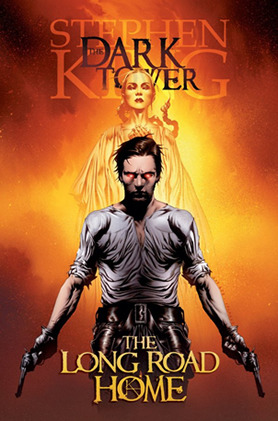
I was killing some time at a Barnes & Nobles bookstore the other day and picked this graphic novel up. I’m a sucker for anything dealing with Roland the Gunslinger, especially back story regarding his younger years, so I figured this was a “can’t miss” for me. Unfortunately, I was wrong.

The story itself begins right after the death of Susan Delgado, as told so hauntingly by Roland the Gunslinger in “Wizard and Glass,” Dark Tower IV. Here, an emotionally devastated Roland and his friends have slipped into the town of Hambry to cut down Susan’s charred body from the Charyou Tree, as Alain and Bert argue about whether this was an idiotic idea. Naturally, things turn toward the supernatural quickly as Roland “loses” it, firing at Maerlyn’s Grapefruit, which instantly turns into an eyeball with tentacles. Said running eyeball attacks Roland, enthralling his soul, even as it incapacitates him. Of course- at this moment – a bunch of local thugs and the last Big Coffin Hunter appear, beginning a chase of our three friends, which drives the frenzied plot forward the rest of the book.

In my opinion, “The Dark Tower: Long Road Home” should best be viewed as a tribute to Stephen King’s original story. While there is nothing inherently wrong with this graphic novel, because it is enjoyable, the fondness a reader feels while viewing it is mainly nostalgia from the return to King’s Mid-World, not an enjoyment from the story itself. No doubt, this tale was meant to be a “filler” of the events narrated in Wizard and Glass and the first Dark Tower book, but Peter David’s narrative really just bounces around through events already mentioned in the Dark Tower novels without adding anything new to them. Well . . . in fairness to Mr. David, it does add one new tidbit: what became of poor, old Sheemie from Hambry. But even this bit of lore, which was the most interesting story arc in my opinion, was merely okay, nothing more than that.

As for the artwork, many of you will no doubt love the scenes created by Jae Lee and Richard Isanove here. Truly, the images spring off the page at a reader, bringing the story to life in a world filled with bright, bloody, red mist and autumnal twilight. Everywhere one looks there are shadowy faces, barren lands, ghastly pursuers or vicious beings of techno-magic. Even during the dream-like sequences, Roland is shown trying to maintain his grip on sanity while existing in a hazy landscape full of withered trees, or “The Good, the Bad, and the Ugly” on acid as I viewed it.

Now, there is nothing inherently wrong with the backdrop that Lee/Isanove created for this story to move upon. No doubt, it arguable captures the horrid situation Roland the Gunslinger is experiencing internally at the death of Susan, his one true love, but it grew repetitive and overblown to me. After a few pages, the red, brooding background faded away as I tried to focus on the story, and in a graphic novel, this is not a good outcome for an artist. When reading a graphic novel, I personally want the artwork to both compliment the story and evoke some feeling within me, make me stop reading to soak in the backdrop, in awe of what the artist has created here. I never felt that in “Long Road Home,” just a constant sense that everything is red and dead.

If you’re a Dark Tower junkie you probably should pick this up. If nothing else, it will satisfy your need for another “hit” of Roland the Gunslinger. On the other hand, if you’ve never read the Stephen King novel, I doubt this one would interest you at all.

Posted in Graphic Novels | Tagged , , , , , , , , , | 3 Comments

Jhereg: Teenage Favorite Disappoints in Re-read.

1281575

My rating is 2 out 5 stars.

I read this novel when it was initially published in the mid-80s. It was a favorite of mine at the time, and I have always recalled it fondly. However, after completing a re-read, it has become painfully obvious that the enjoyment I received from this book must have been one of those teenage fads because . . . it has disappeared right along with my desire to keep solving a Rubik’s Cube.

The tour guide in Jhereg is Vlad Taltos. The world he guides us through is a standard one from 80s fantasy. Here a huge Empire controls most of the world, inhabited and ruled by the Dragaerans, who are basically LoTR-like elves. Indeed, the few humans in this world often refer to the Dragaerans as “elves,” though to “confuse” the reader a bit the author has the Dragaerans refer to themselves as “human.” Other than this one quirk, there is nothing to set it apart from other fantasy worlds from this period of the 80s.

Vlad is one of the human minority of the Dragaeran Empire, labeled by his “elvish” overlords as an “Easterner” and born into the lowest class of society. However, thanks to a social-climbing father, Vlad is actually a citizen of the Empire and a noble of one of the lesser Dragaeran houses. (There are 17 Great Houses in Dragaeran; each named after an animal of the world.) Of course, the house Vlad is a noble of just happens to be one huge criminal organization, which greatly resembles the modern day Mafia. Our protagonist’s role in this elvish “mafia” is as a minor crime lord, supervising certain criminal interests of the “house,” and as an accomplished assassin. To throw in a little “fantastical,” the author also makes him a minor sorcerer.

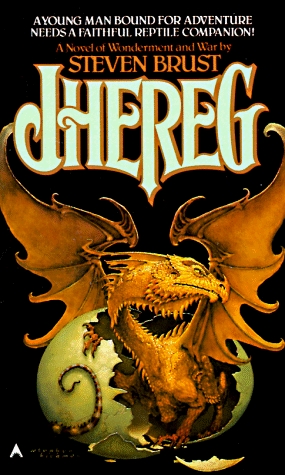
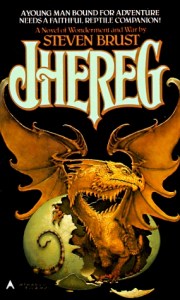
The novel itself starts out with Brust focusing on Vlad’s childhood, especially the story of how he acquires a live Jhereg egg, which later hatches out into his “familiar” Loiosh. (The golden reptile on the front cover of the paperback edition is Loiosh.) The two of them share a telepathic “link;” their constant bantering being the main comedic point of the book, though it does grow tiresome after a while.

After this boyhood tale, Brust time warps ahead approximately seven years to the main action of the novel. (This fast forward effectively leapfrogging three of the subsequently books in the series, making this the fourth in chronological sequence I believe.) Here another “mob” boss hires Vlad to kill one of the Jhereg’s higher-ups, who has disappeared with some money that doesn’t belong to him. The job has to be done quickly before word of this theft can get out and make the Jhereg look “weak.”

Since Vlad is a skilled assassin, the job doesn’t seem like a big deal until he discovers that his target has taken refuge in Castle Black, as a guest of Morrolan the Dragon lord. Morrolan is a heavy-weight Dragon with bad mojo magic. Word is that this Dragon lord is such a tickler for honor that once he has taken someone into his home as a welcomed guest that they are under his protection, no matter what. Plus, Vlad has a professional relationship with Morrolan (a strange friendship even), which complicates everything.

So now, the easy job has gotten complicated, and Vlad spends many pages planning the perfect assassination scheme. Ultimately, the plan boils down to this convoluted scheme to get the target out of Morrolan’s house without using magic and without actually killing him inside the actual castle. (It is much more complicated and cumbersome than that; I’m just trying to make it easier to understand here.) Naturally, things fall apart, people have to improvise, the incident turns into a full blown political situation between the Jhereg and the Dragon houses, and then things get cleared up at the end.

PROS:

There are several nice things about this book, which many reads will no doubt enjoy.

1) It is fast paced – mainly because it is very short – and is written in a flowing style that keeps the pace moving, never bogging down in descriptions or tiresome wordiness.

2) It is also very modern in tone. The magic and other “fantasy” elements here are very straight forward, accepted by everyone in the story as part of every day life and never really discussed. Indeed, Jhereg is so modern in tone that it can just as readily be enjoyed as a contemporary mafia story rather than a fantasy; if the “fantasy” elements bore you, all one must do is just imagine it is all taking place in New York City as opposed to another world.

3) Jhereg is a fantasy detective or mafia story during a time when Tolkien clones were all the rage. So, at least in the early 80s, it was different. Not so much now but still good variety I suppose.

4) The interaction between the men and women of the book is very business-like with a post-feminism flavor. No sexual discrimination here. Hell, no sex here. Lol! Nope, no sexist remarks about females in general or anything like that; everyone appears equal without any distinction between male or female.

CONS:

1) While this book is a fantasy, it has only a thin veneer of it. Sure, there is a bit of magic thrown around here or there, but if not for the strange names and “sorcery,” it is a contemporary story about a mafia hitman.

I read somewhere (I believe it was Ursula K. Le Guin’s book on writing) that in order for a novel to be a “fantasy” she felt it should have such a “fantastical” feel that a reader knew this could not take place down the street. Le Guin even gave an example of this, using an excerpt from a popular 80s fantasy novel. She quoted an entire passage from said “fantasy,” changed the kings to senators, holy priests to representatives and illustrated how this “fantasy” work read like a story about Washington, D.C.. I’m going to try to do the same, but I’m no Le Guin so bear with me.

We ate the meal in silence, enjoying each other’s company, feeling no need to talk. As we were finishing, Cathy said, “So, you get work, while I stay home and wither away from boredom.”
“You don’t look withered to me,” I said, checking. “And I don’t remember your asking me for help with that little matter last month.”
“Hmmmmph,” she said. “I didn’t need any help with that, but this looks like something big. I recognized the target. I hope you are getting a reasonable price for him.”
I told her what I was getting for him.
She raised her eyebrows. “Nice! Who wants him?”
I looked around the restaurant, which was almost deserted. I didn’t like taking chances, but Cathy deserved an answer. “The whole bloody Gambino family wants him, or will if and when they find out.”
“What did he do?” She asked. “He didn’t start talking, did he?”
I shuddered. “No, not that, thank the Virgin Mary. He ran off with nine million dollars in family operating funds.”

I changed only 5 words in that passage. Now, instead of Vlad Taltos the human assassin in an elvish empire, we have Vlad the local hitman, trying to take down a mob boss who has taken off with the family’s cash. And this is only one example and can basically be done throughout the whole book. Naturally, some spots take more than 5 words to transform the story, but you see the point.

This sort of thing doesn’t bother some people. If that is you, so be it. But if I wanted to read a novel about the mafia, I’d rather do so without the strange names and sorcery thrown in. Like I said however, it is a personal choice.

2) Jhereg is written in first-person narrative by the author. Nothing wrong with that in and of itself (Mark Lawrence pulled this off brilliantly in Prince of Thorns), but it does not seem to work here after a while. Quickly, Vlad’s constant descriptions of his actions like “I had my back to the door” or “I approached slowly, sizing him up, reaching for my daggers even though my palms were slick with sweat” began to read like a shopping list. It did not sound natural, and it really limited what I actually saw in the fight scenes, making me feel disconnected with everything else that was going on. Nope, instead of actually reading about Aliera doing something awesome, I have to wait for someone to describe it to Vlad.

Also, I also felt that the first-person narrative made the scene transitions awkward throughout the book and slowed down the general pacing of the story.

Perhaps these complaints are merely personal preference, but as I alluded to, I’ve read other books that pulled off first-person narrative without making me compalin. Maybe it is just me, but it seems that Brust doesn’t do as good of a job with it as other authors – at least in this book.

3) No romance of any kind. I mean, even though Vlad and Cawti are married, they act like business acquaintances. Sure, they talk about work or make dinner for one another, but other than that sort of “friendly” type of relationship, nothing is going on here. Now, I know that might not bother some of you, but I mean relationships, sex, and all that sort of thing is part of normal human existence. The fact that it was totally ignored for the whole mafia hitman thing really struck me as odd.

Yet again, maybe it’s a personal preference. But I thought I’d mention it for those of you who like to see some romance or some hot sex, because you are not going to see either in Jhereg. And before anyone mentions it, I know this was written in the 80s, but my God, Tolkien wrote more smoldering, sexual tension in LoTR than Brust does here.

4) Lastly, if you are one of those people that loves reading about some grand, new world and its magic or history (What we have now label world building) Jhereg is going to disappoint you: the world building is at the bare minimum. Brust only includes the details necessary to remind you this is not happening in New York City and Vlad is not really a hitman, but an assassin in another world. Sure, we have weapons that destroy souls and talk about ancient Dragaeran Houses or the Orb, but they are fleeting, can easily be omitted without impacting the “hitman” plot and leaves one intrigued, but unsatisfied, with his/her knowledge about the “world” Vlad exists in.

To sum up, Jhereg is a decent book. It is entertaining and quickly read, which is why I gave it a 2 star rating. When I was a teenager, I loved the book and would have rated it 3.5 or 4 stars. Unfortunately, some things do not age “well,” and this book is one of those things in my opinion. It just pales in comparison to the type of fantasy novels we have all grown accustom to these days. But if you are needing to waste a couple of hours and don’t want to read another “detective” novel, pick this one up. It might make you *YAWN* in its simplicity, but it probably will keep you awake long enough to finish it.

Posted in Fantasy | Tagged , , , , , , , , , , | 2 Comments

Squadron Supreme: Blast From the Past!

51jyZgnXhNL__SY346_

My rating is 4 out of 5 stars.

Marvel’s one hundred (100) percent ripoff of DC’s Justice League of America. I mean, it was obvious Hyperion was Superman, Doctor Spectrum was Green Lantern, Power Princess was Wonder Woman, et cetera. No one ever tried to make a secret of it. So why in 1986 did I feel a need to buy a Justice League copycat when I could have just read the DC original?

Simple answer: Mark Gruenwald.

Say what you will of Gruenwald, but he was one of the best comic writers of the time imo. He was that rare writer who could take something absolutely not cool (Prime example is Quasar) and make it readable. Gruenwald could go even further, crafting a relevant, thought-provoking storyline without having to turn his comic into a mature, adult-only book. This is exactly what he did with this mid-80s mini-series.

We pick up the Squadron Supreme of Earth-712 dealing with the aftermath of their paramount failure: becoming mind-controlled pawns of two super villains who used them to rule over and destroy Earth-712. With the aid of the Defenders, the Squadron has previously regained their freewill, defeated the villains but is left with a post-apocalyptic earth to rebuild. That leads them to the ultimate question every team of super-heroes contemplates: why don’t we just take control of the earth and make it into utopia instead of dealing with all these idiotic politicians and governments? (Honestly, if you were Hyperion/Superman or Power Princess/Wonder Woman, can’t you envision that question bouncing around in your heads 100 times a day?) This series explored exactly what would happen if a team of super-heroes answered that question by saying: “Hell yes, lets take over.”

The story that follows has its up and downs, but it generally stays true to this initial premise. We see the team splinter over their decision; friends become enemies instantaneously over ethical questions. Moral issues of a person’s inherent right to freedom of thought are explored, and we have – in the comic book sense of that time – terrible consequences rain down upon the heads of our enlightened despots. Numerous deaths directly and indirectly result from this conflict of ideals, which at the time was somewhat surprising of this type of comic. In the end, our remaining heroes show us exactly what can occur when power is not used wisely.

Now, before anyone mentions this, I am not saying this series compares to the Watchmen. Squadron Supreme is not the same “type” of mature comic as Watchmen, so a side by side comparison is not fair. However, Squadron Supreme was very forward thinking in its exploration of the interplay of power, responsibility and inherent freedoms of others in the decisions of super-heroes, and it showed the writing ability of Mark Gruenwald. For those reasons, it was well worth the read.

Posted in Graphic Novels | Tagged , , , , , , , , | 3 Comments

Review – Three

Check out this book review.

Literary Titan's avatarLITERARY TITAN

Three4star

Three is a post-apocalyptic sci-fi adventure novel. It follows a strong lone gunman type protagonist named Three, though gunman is probably not the right word as ammunition is hard to come by and he dispatches foes with is sword more often than not. In the beginning of the story he is a bounty hunter that enjoys his solitary lifestyle until one day he finds a woman and her son in need of help. To him there just more beggars amongst many that are starving, scared and in need of help. He doesn’t really help strangers without it profiting himself in some way, but for reasons he can’t explain, he wants to help these people and changes, for the better, in the process.

Before I go into the rest of the book let me first say that there is a lot in this book that the reader is left to assume…

View original post 711 more words

Posted in Science Fiction | Leave a comment

Star Wars: Kenobi Gets It Right!

A long time ago in a galaxy far,
far away . . . .

star wars

EPISODE III ½

The Trials of Tattoine

Gone! The Galactic Republic has been
erased from the pages of history by the Sith.
Palpatine and his apprentice Anakin Skywalker
having destroyed the Jedi Order and
founded the Galactic Empire!

But there is still hope! Yoda and
Obi-wan Kenobi survive, fleeing across the
vastness of space with Anakin’s infant twins.
These fragile children the only hope of one day
overthrowing the vile Sith overlords and
restoring peace and security to the galaxy.

With the whole Empire searching for him,
Obi-wan takes infant Luke Skywalker to Tatooine,
to live among the rugged desert dwellers.
With his heart broken and injustice all
around, how can Obi-wan turn his back on
those in need – even when the fate of
the galaxy requires it . . .

The story crafted by John Jackson Miller begins there: Obi-wan having just arrived on Tatooine and wishing to remain inconspicuous. With Palpatine hunting all Jedis and Luke in tow, our favorite Jedi Master’s mission requires him to not become involved, but to place Anakin’s son with the Lars and watch over him. However, within minutes, Obi-wan finds himself involved in a blaster fight, trying to save people without revealing his identity. It seems that, even when he tries, Obi-wan cannot remain outside events, but is subconsciously drawn to them. Thus, he determines to settle in an abandoned house at the edge of the Jundland Wastes, because surely he cannot become embroiled in anything out on the frontier of civilization.

And the waste is surely the edge of Tatooine civilization. On one side of the invisible line, there is desert and rugged mountains with only Jawas and Tusken Raiders for company; on the other, there are the rugged farmers, who scrap a living moisture farming, and fighting hard against their savage neighbors: both the Tusken Raiders and Jabbas’ gangsters in town. To make the situation worse, an especially fierce tribe of Sand People has camped near Obi-wan’s place, lead by the fearless Plug-eye; their gaderffii constantly raised against their neighbors.

Giving the situation, it is no surprise when Obi-wan is forced to decide between obscurity or notoriety. When a local girl is put in harms way, our hero intervenes, only to discover that she is the daughter of the oasis’ mercantile owner: Annilee Calwell. Annie is a widower and immediately takes a “liking” to the mysterious stranger, who has saved her daughter. As the owner of Dannar’s Claim, she is also one of the most well-known people in the oasis, and news of her daughter’s rescuer spread around the frontier, much to Obi-wan’s chagrin. Soon, our Jedi Master is a local celebrate, known all around as Ben Kenobi, who lives out by the waste. But the funny doesn’t stop there, because Orrin Gault, a wealthy farmer, approaches Ben about becoming part of the Settler’s Call: a local militia that protects the settlers from the Sand People.

What is Obi-wan Kenobi to do?

His Jedi nature tells him to help those in need, but he also must remain hidden so as to watch over young Luke from afar. Above all these things, Obi-wan is torn apart inside. The fall and death of Anakin (He believes he killed his former padawan) is leaving him guilt ridden, and yet the greatest loss he feels – the one he cannot come to terms with – is that of the Jedi Order itself. For as he himself puts it: “I’ve never lived without the Jedi Order to fall back on, to help me when things went badly. What does it mean to be a Jedi alone?”

The tale that results from all of this is an entertaining one, making one hear the triumphant Star Wars music play in the background at every climactic moment. It is definitely meant to be a bridge story between the ending of Revenge of the Sith and the original Star Wars: A New Hope, explaining the whys and hows of Obi-wan’s initial time on Tatooine, but Mr. Miller never gets bogged down in those details. His book introduces enough original characters from the frontier and plausible plot lines that it never feels like just a history book. Indeed, the rousing fights between Sand People and settler, betrayal of one friend by another, and ultimate conclusion of the “frontier” problems are all page turners. But the books most poignant moments come from the passages where Obi-wan is meditating, trying to emotionally survive the loss of every person he has ever loved and depended on. It is there in those quiet moments with Obi-wan Kenobi that this book gets it right.

Netgalley provided me with a free copy of this book in exchange for an honest review. The review you have read is my own personal opinion.

Posted in Science Fiction | Tagged , , , , , , , | 2 Comments

Fantasy Violence: Too Realistic or Not?

Many reviewers believe fantasy has become too violent, too ultra-realistic in that violence. Many of those critics point to Mark Lawrence’s series The Broken Empire as a prime example of their premise. Since Emperor of Thrones was released today, I wondered what everyone else thought, so please vote in the poll and leave your comments.

Posted in Musings | Tagged , , , , , , , , , , , , , | Leave a comment

Big Release Day for Fantasy Fans!

Lots of great, epic fantasy books being released today.

15804760

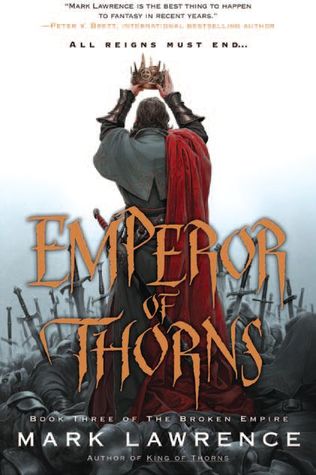
Emperor of Thorns (Broken Empire) by Mark.Lawrence

crowntower-2-5

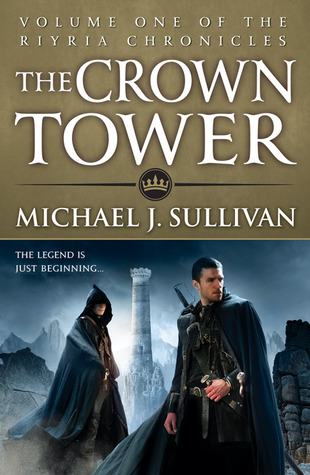
The Crown Tower(The Riyria Chronicles) by Michael J. Sullivan.

16142151

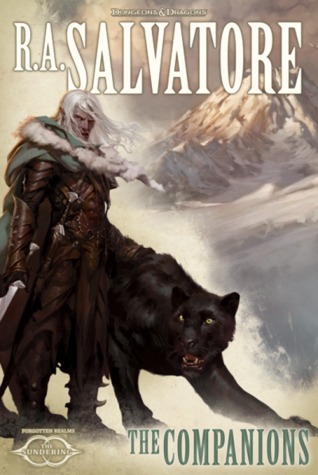
The Companions (The Sundering) by R.A. Salvatore.

I’m looking forward to the first two, have already enjoyed the last. See my review of The Companions by Salvatore here.

Posted in Fantasy | Tagged , , , , , , , , , , , , , | 2 Comments

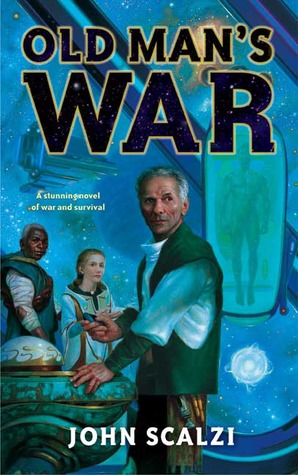
OLD MAN’S WAR (OLD MAN’S WAR #1) by JOHN SCALZI

1406395
My rating 4 out of 5 stars.

In the future, mankind has finally spread out into the stars. Humans from overpopulated countries around the world taking to the stars routinely to found colonies on numerous worlds. There has been no new “renaissance” from this otherworldly exodus on mother Earth however. No change in the sociopolitical norms. Nothing different in the daily life of an average citizens of the United States or any other industrialized country. Indeed, most pay little attention to the news that comes from beyond the globe. It does not affect their daily lives, which revolve around the normal things: getting married, going to work, raising children, and hoping to have enough savings to enjoy their old age.

And, really, there is no need for people of Earth to concern themselves with “out there” anyway. That is what the Colonial Defense Force (CDF) does. It manages and controls everything to do with other world colonization. It is their bureaucrats who decide upon the individuals who take to the stars. Their space station which orbits the Earth. Their skip drive ships that leave from that station to transport both people and materials out into the vastness of space. The CDF even controls the flow of information from those colonies back to mother Earth. Under their supervision, the spread of mankind to the stars has become almost hoo-hum; nothing to get excited about at all.

The only time when a citizen of a rich country even concerns themselves with the CDF is at age seventy-five. For at that age, you have finally become old enough to join the colonial armed forces. Why sit at home, feeling death creeping up upon you, and using up valuable resources when you could join the proud, the few, the colonial defense force!. You’ll never see Earth again, but in return, you will experience the unknown wonders of the galaxy and be given back your youth. How the CDF restores you back to twenty years old is a mystery, but it is a great incentive for seniors to get out of their recliners and head to their local CDF recruiter.

John Perry is one of those seniors who sees nothing for himself on Earth but a countdown to the grave. His beloved wife has already died, his only son is grown, and hanging around to be a granddad on traditional holidays doesn’t hold any allure. Thus, he heads off to the CDF to see something of the colonies and – more importantly – to recapture his lost youth. Maybe his second chance at life will produce as much happiness as his first trip did.

Once he rockets off into space for the nearest human colony, John begins to understand exactly what he has signed up for. The CDF was not lying when they intimated that he would be given back his youth. However, his old, worn out body must be discarded for a young, superhuman body that has been thoroughly tested and patented by the CDF technology division. This new body is genetically modified and enhanced by nano-technology and alien dna. (Not to mention that it is green.) But the worst part is that all these modifications of his frail, human form have been made for the simple reason that otherwise he would have no chance to survive his tour of duty in the CDF!

The galaxy is a very dangers place if you are a human, John learns. The CDF has been guarding the Earth all these centuries, protecting it not only from the aliens’ menace but also from the realization that the majority of the galaxy views mankind as a tasty snack. An animal to be captured, breed, fattened up and then savored at dinner with a nice, white wine. That is why the CDF has hidden the truth from people on Earth. Why they only recruit old people who have already had a chance to live their life. The reason John Perry and his friends “The Old Farts” onboard their outbound ship have to shed their ignorant bliss and become soldiers. Because now that Earth is in the rear view mirror, they are not on top of the food chain anymore!

I’m sure this sounds eerily similar to Heinlein’s Starship Troopers for many of you, but Old Man’s War is a very different flavor of science fiction novel: more tailored toward readers who do not like military fiction or scientific theory. Oh, there is a bit of both here: chapters dealing with military training, combat skirmishes and “theoretical” explanations of basic, future technology. However, Mr. Scalzi never spends much time with an subject, merely introduces enough information to keep one in the “know” before continuing on with the story of John Perry.

And a wonderful story it is. John Perry quickly becomes one of those ordinary guys who turns into a natural “hero”, not because he is gifted above his friends or finds some alien technology that gives him an edge but because he uses his wits and is lucky. His easygoing and sunny disposition is instantly likeable, as he seamlessly alternates between being a grieving old widower too becoming a funloving friend to the other “Old Farts” from his recruitment ship to just trying to survive as a grunt in the trenches of a war against vicious aliens. Mr. Scalzi writes each facet of our heroes story superbly, making a reader both understand and empathize with him all along the way of his second life.

Of course, there are problems with this novel; there always are. Here Perry becomes the person who always has the epiphany which saves the day. He is the guy who always survives the grenade event though he was closest to it. The foot soldier that is honored by his enemies even though he is a nobody in the trenches. When a plot line late in the novel involves a person from John’s past, it doesn’t surprise anyone that once again fortune has smiled upon him. Simply put, it is good to be John Perry in Old Man’s War, and that does distract from the overall tone of the narrative a bit.

Even with these annoyances, Old Man’s War was a joy to read. The writing was clear and concise, easy to consume, and John Perry’s journey from ignorant, protected Earthman to wise, veteran soldier of the Colonial Defense Force was a joy to read. I could barely put it down when I read it, and I am sure you will do the same if you give it a try. So stop reading this review already and go get a copy of the book.

CHECK OUT MY REVIEWS OF THE SERIES
THE GHOST BRIGADES

BUY THE BOOK AT AMAZON

Posted in Science Fiction | Tagged , , , , , , , | 10 Comments

THE EMPEROR’S EDGE (EMPEROR’S EDGE #1) by LINDSAY BUROKER

THE EMPEROR'S EDGE

The Emperor’s Edge by Lindsey Buroker

Genre: Fantasy

Series: The Emperor’s Edge

Publisher: Self published (January 1, 2010)

Author Information:Website | Twitter

My Rating: 2 out of 5 stars.

After all my friends had positive things to say about The Emperor’s Edge, I decided to give it a try. Any novel that was described as “one of the bright stars of fantasy self-published fare” was something I had to read. (For those who were wondering, one of my friends used that description.)

Well, after finishing this one, I can understand why so many people adore Lindsay Buroker’s steampunk fantasy epic. However, the fun, campiness of the tale underwhelmed rather than charmed me.

The Emperor’s Edge begins with Amaranthe Lokdon, a woman enforcer, of Stumps, the capital of the Empire. As a female officer, she is a rarity in town (even though women are the business owners of the city) and a stickler for proper enforcer behavior, determined to rise up the chain of command so that she can change all the wrongs of the male-dominated department. One day, Amaranthe finds herself patrolling the city when she stumbles upon a crime; thereafter, she single-handedly takes into custody several “bad guys” while unbeknownst to her the young emperor watches. Thereafter, Emperor Sespian complements her for her daring-do, bides her au revoir and that is that — though he is somewhat fascinated by her.

But a single pebble can begin a massive landslide. At least it does in this novel, where the brief meeting between the young Emperor and a female police officer sends tremors through the status quo at the imperial palace. For you see, Commander of the Armies Hollowcrest has been the real power behind the young Emperor for years, viewing his young charge as a mere figurehead while he holds the true reigns of power in the Empire, and when he hears that Sespian has an interest in a female enforcer he views it as a threat to his monopoly over imperial power. (Why he feels this way is never fully explained.) Thus, the commander determines to kill Amaranthe. But since arranging the disgrace, disappearance, or death of a police officer is too much for the most powerful man in the Empire to facilitate, he personally meets with her at the imperial palace before sending her off to kill the most wanted assassin in the empire. All this done to get her out of the way.

Did I mention that Amaranthe had met the emperor only one time for maybe 5 minutes? Yeah, I guess I did mention it didn’t I.

Anyway, from this somewhat head-scratching beginning, the plot moves forward with Amaranthe quickly turning into a rebel against Hollowcrest. Soon, she gathers together a motley group of people whom she convinces to aid her in a plot to destabilize the Empire; all of them somehow getting onboard with trying to overthrow the most powerful man in the Empire — even if it might mean their deaths.

Now, to say, Amaranthe is the star of the tale that follows is like saying Batman is the main character of his movies. It is without a doubt a fact, not a theory, and in The Emperor’s Edge, Amaranthe quickly morphs from a simple police officer into a “Mary Stu” character. Only she can charm the most heartless of men. Only she can escapes death time and again. Her goodness of heart turning even the most hard-hearted criminal into her ally. Soon, she is not only capable of outwitting the most powerful and corrupt politicians in the empire, but also outthinking the most devious spies and wizards. Hell, even biological weapons have no chance against Super Amaranthe!

When I spoke these feeling out loud to my friends, they immediately pointed out that Amaranthe’s “Mary Stu-ness” and the somewhat silly plot was all campy fun. The eye-rolling luck of the good guys very much like an old school superhero comic or a classic, pulp fantasy. And I totally agree that it can be read that way, because Buroker does seem to emphasize the humorous camaraderie between Amaranthe and her helpers over the complicated realism of a true epic fantasy thriller. However, even though I did warm up to Amaranthe’s interaction with her co-conspirators, the unrealistic campiness of everything grew into more of a negative with me rather than a positive. Something that inevitably ruined my overall enjoyment of this novel.

So to wrap this up, The Emperor’s Edge is a fantasy set in a world of steam with some fun characters and many laugh out loud moments, but the only way to fully enjoy it is to accept that campy adventure is the rule, not the exception here.

Buy The Emperor’s Edge Collection (Books 1, 2, and 3) at Amazon.

Posted in Fantasy | Tagged , , , , , , , , , , , | 3 Comments

Game of Souls Might Steal Yours.

17453142

My rating is 3 out of 5 stars.

Game of Souls comes out swinging.

The tale starts off with an assassin contemplating his latest job. This assassin is not concerned with plans or worries of how he is going to accomplish his mission however. No, he hopes his latest target will actually give him a challenge!

But the surprises do not stop there because immediately the assassin’s target does something totally unexpected. (Can’t tell you what because it would ruin the surprise.) This event sets up a classic confrontation, teasing one with a whole set of mysteries that require answering.

Unfortunately, as the tension is building for a big showdown, these two dynamic characters disappear. The story then jumps forward in time by a decade and a half at least; our assassin and his target lost in the hazy past.

This will no doubt disappointed a lot of readers, but you should not lose heart: just keep turning the pages. For after time shift, a whole new set of characters are introduced quickly, and a different plot is put into place. Mr. Simpson also uses these introductory chapters to world build, laying out simply and quickly the history of an empire, the ruling elites games of power, and the downtrodden people and their position as shunned citizens. He also weaves an interesting – though complex – magic system of Melders, who are individuals who can call upon the power of their “soul” to do marvelous feats of magic.

After this foundation is laid, the world of Game of Souls comes alive as Keedar, Melder from the slums, and Winslow, son of a powerful noble, are slowly drawn together. Their individual stories gradually intertwine and become a driven pursuit for truth of their lives and for the ability to master the eight cycles of the “soul.” Thrown in a good dose of political intrigue and mysterious legends, and you have a good, old-fashioned page turner.

Take a chance on this one, but be careful Mr. Simpson’s writing jsut might “steal” your soul.

Posted in Fantasy | Tagged , , , , , , , | 2 Comments