Posters Beware on Suvudu

Warning of sort for bloggers who submit their material to Random House’s community generated content site named Suvudu Universe. It seems that Suvudu takes control of the submitted material like most sites these days, so everyone has to be aware of that and decide if the additional attention is worth the risk of losing control of your product. Read about it and decide for yourself. http://www.staffersbookreview.com/2013/08/suvudu-universe-hai-can-i-haz-ur-stuffz.html

Posted in Reviewer News | Tagged , , , | Leave a comment

Why Indie Authors Need Professional Cover Art.

As someone who has no shame admitting I’ve purchased fantasy/scifi novels just because I found the cover really cool, I found this article regarding the necessity of professional cover art for indie books interesting. Perhaps you will as well. http://www.indieauthornews.com/2012/10/bad-cover-bad-sales-why-you-need-professional-cover-art.html

Posted in Writer Resources | Tagged , , , , , , | Leave a comment

Brief Blog About Jack Vance

Take a look at this brief look at Jack Vance. http://www.shelfinflicted.com/2013/08/jack-vance-part-one.html

Posted in Author Spotlights | Leave a comment

On Grittiness & Grimdark

An article which compliments my grimdark musings. Read both and think about it.

fozmeadows's avatarFoz Meadows

Last week, Joe Abercrombie wrote a lengthy post in defence of grimdark fantasy, a stance which should come as no shock whatsoever to anyone familiar with his books. (Which, for the record, I’ve read and enjoyed, albeit with reservations.) The pro/con debate over gritty SFF is comparatively new, in the sense that its status as a distinct subgenre is comparatively new, but not so lacking in history that we haven’t already built up a fairly substantial archive of dissenting opinions. What struck me forcefully about Abercrombie’s essay, however, was his failure to acknowledge, let alone address, a key aspect of the debate, viz: the ways in which grittiness is racially, sexually and culturally political, and whether or not those elements can ever be usefully disentangled from anything else the concept has to offer.

“Portraying your fantasy world in a way that’s like our world?” Abercrombie asks. “That’s only honesty.”

View original post 1,227 more words

Posted in Musings | Leave a comment

Why Grimdark Isn’t For Me!

111222

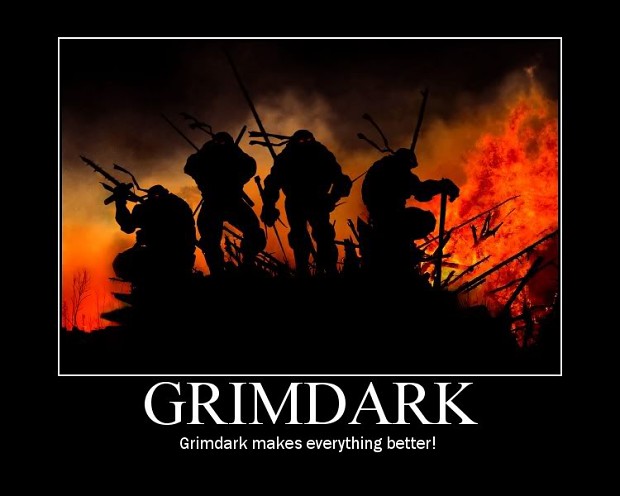
Like the headline boldly announces and the picture clearly illustrates, everything is cooler when it is grimdark, which seems to mean lots of amoral, ultra-realistic killing and maiming will even make the Teenage Mutant Ninja Turles badass.

Well, I’ve pondered that idea for a while now, and the thought that grimdark might become the face of fantasy has really begun to bother me. A feeling that came to a head after I finished reading two, very different fantasy novels in the last few weeks: one standard, old-school fare with “heroes” and the other a grimdark work with a “villain” at the helm. (While I don’t believe most grimdark fans would label the protagonist in that book a villain, by old school labels (which I’m using here) I really think he would be.)  And as I sat there wondering why these books had called into question my desire to read anymore grimdark novels, I began asking myself “What kind of fantasy protagonists do you like and why?”

To be clear, the characters who brought this question to my mind were Hadrian and Royce from The Riyrian Revelations, as written by Michael J. Sullivan, and Jorg Ancrath of The Broken Empire, as penned by Mark Lawrence. For those unfamiliar with these famous fantasy protagonists, let us look closer at each.

Hadrian and Royce are two separate individuals: the former a great swordsman with chivalrous values,the later a cold and deadly thief/assassin. However, these two find themselves thrown together as business partners and have become friends of a sort, but their outlook on life remains distinctly different. I like to think of them as two-sides of the same coin.  Hadrian being the “good” side; the classic hero who wishes to treat everyone well, rescue every person in distress, and never take advantage of anyone.  Royce, on the other hand, is the “bad” side of the coin; he won’t flinch at killing whomever needs killing, finds it practical to use every advantage in a fight to win (even cheating), and really wonders how anyone as “naïve” as Hadrian could survive more than five minutes in the real world.  However, through their constant interactions, Mr. Sullivan shows how gray morality really is, though it is definitely a lighter shade of gray.

The infamous Jorg Ancrath is a young man who I like to describe as Hannibal Lecter with a sword. Most reviewers (whether they love Jorg or not) concede he is a sociopathic narcissist, who views the world as revolving around himself and hates everyone, is willing to torture, rape, maim, or kill whomever he wishes, and views the survival or comfort of all humanity as meaningless, because their lives mean nothing to him – even his faithful followers. It has been suggested that Jorg’s egalitarian violence is merely his attempt to cope in a world that has failed him; a deeply held belief that since god, society, and humanity itself allowed a truly horrible event to happen to him and his family that he is justified in doing whatever he wishes to whomever he wants.

Wow, talk about two extreme differences in characters!

So, what “kind” of lead character do I prefer in my novels.

Since I’m a human being, I’ve went back into my memories to contemplate those characters who had an emotional impact on me in the past. Frodo from Lord of the Rings  comes to mind. Thomas Covenant from the series of the same name popped up. Croaker from The Black Company novels by Glen Cook reared his head. There are many more, but these stand above the rest in my memory.

I believe each of the guys listed above were heroes or anti-heroes. Frodo was the absolute “good guy,” doing what was right because it was right. Thomas Covenant was the “anti-hero: the leper, the whiner, the unbeliever, the rapist, who both ruined everything around him and saved it. And perhaps my favorite, Croaker, who was somewhere in the middle; the mercenary who had killed, raped, maimed for years and still did when the occasion required it, but who tries to avoid it where possible. Yet, even in their differences, these lead characters showed me what I was looking for: someone with a set of moral beliefs, who tries to do what they perceive as the right thing.

Classic heroes,” I hear you saying to yourself.

Well, Frodo obviously is that. However, I don’t think Thomas Covenant was a classic hero by most accounts. Generally, readers hate him, even if they enjoyed the books. Croaker cannot be labeled a classic “good-guy” at all; he fights for the “bad guys” a large majority of the time, is not afraid to commit atrocities when necessary, and generally lives by the mantra “the end justifies the means.” However, Croaker and the other two have one important thing in common: they have an invisible line drawn in their head, and when they are about to go over that line into the realm of villainy, they usually stop just short.

But everyone perceives the right thing differently” I can hear some of you saying.

Yes, everyone does see right and wrong differently. But there are some general, moral principles almost universally agreed upon by humanity. Simple things like “It isn’t right to eat other people!” I think that one is generally accepted by most of humanity, though it might not be per se “illegal” in many countries.  “You can’t rape someone just because you feel like it!” Don’t know anyone who disagrees with that one. “You shouldn’t torture people just because you like to hear them scream!” If you disagree with that statement there are some mental health diagnosis to describe your condition. Those are the type of universal morality I’m speaking about; the big “no-nos” humans generally agree upon.

After reflection, it seems I prefer traditional fantasy protagonists because they don’t glorify the breaking of all the big “no- nos” of mankind. These traditional heroes can be gritty. They can be merciless and gory in battle. They can assassinate people. Hell, they can be “ultra-realistic” with their own jaded morality! But since they pull themselves back from crossing that final line into absolute depravity, I can live with their decisions not being what I personally agree with. These characters are individuals, after all, and while I might not conceive of doing certain things in the comfort of my recliner at home that doesn’t mean these fantasy characters living through extraordinary circumstances wouldn’t do something completely different from me. However, too many grimdark authors seem to be obsessed with lead characters who glorify violating all the big “no-nos” of humanity.

Now Mr./Ms. Grimdark Writer, I know you are an artist, and in the fantasy world of today, “grimdark” seems to be the place to show how sophisticated your writing is by making it gruesomely realistic. I understand. I even agree more realism is an improvement over some of the campy nonsense in fantasy from decades past.  But please go easy on the “All sentient beings are animals to be raped, tortured, killed and feasted upon for entertainment value!”  Honestly, it isn’t sophisticated to write that sort of story nor is it “artistic.” Rather it is simply “shock writing,” where you throw atrocity after atrocity at a reader in an attempt to keep them entertained.  Very similar to Hollywood movies where every other scene has an explosion or killing to distract a viewer from the fact nothing else is really going on.

So my point is that I hate grimdark and want every fantasy novel to be headlined by a Hadrian or Royce clone?

Nope. I am not saying either of those things. Grimdark can be terribly entertaining. I personally thought Prince of Thorns was an amazing novel; I merely hated Jorg Ancrath.  And while I love reading about Hadrian and Royce, what makes them interesting is that together they aren’t either “good or bad” but a shade of gray. So what I’m actually attempting to put into words is that I personally have an invisible line regarding human decency that even a fantasy character shouldn’t cross too many times before I begin to view them as a monster and shut their book.  I mean, I love big action movies as much as the next person, but if I hate all the characters the number of explosions really isn’t going to keep me watching.

Posted in Musings | Tagged , , , , , , , , , | 6 Comments

The Expanse series, by James S. A. Corey

Great review. Check it out.

Charlotte's avatarBlogging for a Good Book

G8When I started this science fiction series two years ago, I had only one complaint. In the opening scenes of Leviathan Wakes, I was introduced to Juliette Mao, a jiu jitsu-trained racing pilot who had run away from her corporate pig parents and was now kicking her way out of a storage locker on her hijacked ship. “Great!” I thought, “I am so ready to read about this woman’s adventures!” And then she died.

I sighed and continued reading about protagonists Jim Holden (cowboy in space) and Joe Miller (hard-boiled detective in space), and I enjoyed their fast-paced fight against an out-of-control weaponized protomolecule that zombifies biological matter. There were female characters in the background. And there were horrible creatures of both genders, or at least as far as one can tell with zombies. But I missed Julie Mao.

So I am happy to report that as the series goes…

View original post 416 more words

Posted in Science Fiction | Leave a comment

Are you a reviewer? We’d like to get in contact with you.

Opportunity for any reviewers to work with a new publisher. Check it out.

dagdapublishing's avatarDagda Publishing

Hello great world of WordPress. We are always on the lookout for reviewers and review blogs to send our publications to. If you run a blog or site which reviews poetry and fiction, drop us a line at info@dagdapublishing.co.uk, or leave a comment here and we’ll get back to you. We already have a growing list of contacts in the online and traditional genres of media, and we’d love to add you to that list.

If you’re not a reviewer, but think you know someone who may be, can you help us out by reblogging/retweeting and sharing this post around? We are a small publishing company and any help from you will mean the world to us 🙂

View original post

Posted in Reviewer News | Leave a comment

Authors Need To Shut Up!

We’ve all done it: fallen in love with a celebrity of some sort. Perhaps it was an actor or maybe a musician. For me, it was fantasy and science fiction writers.

It all started when I was a teenager. Not going to bore you with the teen angst and being “misunderstood” by my peers, because . . . that would be a lie. I read fantasy for one reason: it was bad ass!

When I picked up a book by Tolkien, Moorcock, Asimov, Weis and Hickman or others, I was transported for a few hours to a fantastical place, where magic changed the course of the world or robotic ships took men to the stars. And when I finally put those books down, I believed with my whole teenage heart that these writers were marvelous men and women for gifting me with their visions.

Naturally, my respect (I left adoration behind me at about the age of nineteen) for writers led me to start “following” them on social media when that became all the rage. I’ve tagged along behind my old favorites and new for several years now, read their blogs, savored their tweets, and digested their other social media tidbits. Having “experienced” these authors views on many things, both literary and philosophical, I’ve had an epiphany: some authors just don’t know when to shut up!

Now I suppose this isn’t a huge secret I’ve discovered. I mean, writers have to be opinionated to write and put their feelings and ideas out there for the world to see. Some writing historians have told me most authors are narcissistic by nature, completely in love with their world view. I can see where that might be correct. Lord knows, there have been enough authors with serious, mental health issues. Hell, I’ve google searched a few myself, fascinated by their psychosis. However, the problem nowadays isn’t that more authors are narcissistic or even that there are a greater number of authors, but that it is just too easy to interact with them.

In the dark ages of a decade or so ago, you might have to wait a year or more to read your favorite authors new book and get an infusion of their outlook on life. Not anymore! Nope, today you can grab your ipad, sit on the couch eating popcorn, and read all about your favorite author’s personal views.

In fact, shooting off your mouth on social media is a requirement of being an author these days. Self-marketing I believe its called. All the experts teach that authors need to be more “personal” with their readers: tweet with them, facebook with them, and all the rest. So now, an author is instructed to be out there 24/7 spouting off his or her mouth for the whole internet to read.

The experts didn’t ask me, but I think that is one the stupidest ideas EVER!

I already can read some of your lips as you are saying, “Hey, I love interacting with my favorite author!” Just hold up with the nerd-rage and hear me out.

To be fair, I’m not referring to every author out there. Many are genuinely nice people. They plug their books, link to funny pictures, discuss articles about writing/publishing or talk about stuff that happened to them in day to day life. Just normal people on social media. No big deal there at all. If they espouse political or moral positions through their works of art that is fine; they are artists, and their books are their art. No one is complaining about that at all. We are talking
about social media activism and bad behavior.

So with that exclusion, we move on to the next category of writers on social media. The ones who believe their readers are idiots but are grateful for their career, kept humble by their innate knowledge that if a lot of people didn’t love to escape reality by reading about vampires, wizards, Greek gods or teen angst, they would be working at Barnes and Nobles part time and hoping to get a job as a middle school English teacher. These writers may show their contempt for their readers occasionally, but they are quick to cover it up with an “I’m having a bad day” excuse. Once again, that is cool, we all get annoyed by people at times, and at least, these guys try to be courteous to everyone – most of the time.

But then . . . You knew there was a “but” coming right?

But then there are those few authors, who believe they are “special.”

You’ve “followed” or “blogged” or whatever with these guys. The author who tweets 12 times a day about all his unpopular, personal beliefs and tells you he doesn’t give a fuck if it offends you. The writer who starts long blogs about the deeper meaning of life and how ignorant “normal” people are. The novelist who “preaches” to her readers about their political affiliation, labeling them as “close-minded idiots” who are contributing to the killing of children in ________ (insert third world country name here.) Those are the “types” of authors I’m referring to here.

These guys aren’t the majority of authors on social media, but they make up far more of the whole than I would have imagined, and they seem to honestly believe that, as soon as they published a book, they have been ordained as the divine prophet of some writing god. (Traditional and e-publishing count equally these days. Guess it’s sort of like getting a priests license over the internet.) I suppose the gods (or scientific method for some atheists out their) have wiped away the fog of stupidity from their minds, gifted them with a vision . . . no an epiphany about EVERYTHING!

Honestly, I don’t like saying this stuff about authors. Hell, as I grew up, I wanted to be one, though I never really applied myself to obtaining my dream. No, I’m not a journalist major or the survivor of numerous creative, writing classes. Nope, I’m just an ordinary guy who still likes reading fantasy and science fiction.

But the truth is the truth, and though I resisted seeing this problem with some of my favorite authors, the truth finally stood up and slapped me, or rather, in this case, appeared before my eyes in a blog. Honestly, it hurts when people you looked up to disappoint you, especially the “intellectual” authors who you always thought would be more open-minded than ordinary people. I mean, they have written about dragons, sorcerers, elves, robots, cyborg love triangles, et cetera the majority of their adult life. You would assume they’d be the last person to bash someone for having idiotic beliefs or morals. *Shrug* Guess you can be wrong about anyone.

As I alluded to, finally, an incident occurred where I read an author completely insulting and demeaning his fans. It appears that this writer felt that if his fans had a certain belief or political affiliation they were subhuman, uneducated idiots, who should be withheld medical treatment when they were ill. Yeah, he/she said everyone of these things about people on his/her personal blog and other social media accounts. Talk about nerd-rage. Wow!

Now, disagreements in life are a natural occurrence, and that is especially true in social media world. Nerd-rage is a regrettable but common occurrence when you have a computer screen and a thousand miles between you and the person you are insulting. But I’ve noticed these activist authors don’t need anyone to insult them before they go “nerd-rage” on their fans. All that is necessary is that you don’t respond to their tweet with an “Oh, praise you most high intellectual author for favoring your followers with this divine message.” If the response is anything else, you are going to get a well-written, very entertaining, euphemism filled tirade – plus you will get free editing of your comment, because everyone enjoys someone pointing out your ineffective use of punctuation or improper word usage.

Unfortunately, I’m not just trying to be funny with that last statement. I’ve read exactly that done to a fan on another writer blog. In this case, a reader wrote a humble criticism of an author’s inability to do anything on his/her blog except rant about political/social issues. This unfortunate reader made the horrid decision to put a curse word in his critic. What he received in return was a full page article filled with euphemisms comparing his idiocy to every insulting think under the sun and insinuating that he was not a man. The author didn’t call this poster any politically incorrect names but merely said his warped, inbreed, ignorant attitude had no doubt kept him from ever being able to have sex with anyone and probably contributed to his inability to use appropriate punctuation. All that for a criticism and one cuss word. The really sad thing was all the author’s “followers” (I believe bootlickers would be a better description) who were high-fiving over the stunning prose and illustrative euphemisms of their favorite writer bashing this “unbeliever,” whose sin was daring to point out he would like to read more about books on the writer’s blog and less about social/political issue.

Naturally, I couldn’t join in the fun. As I kept reading the novelist’s rant, all I could think about was this wasn’t good “marketing” on the authors part; did the publisher know this was going on; and didn’t Mr. Writer’s get horrid reviews on his last novel about a vampire sorcerer who had to journey across the multi verse to find the blue, crystal orb of elements. . . You’d think one of these things would have kept this “artist” from casting out such hateful criticism at someone who actually bought his books. Guess not.

Now, I know those are just two examples, and some of you are yawning saying 2 examples doesn’t prove anything. Unfortunately, there are many, many more every day. Perhaps not this excessive behavior but very close. Just to prove this, I’ll give three more examples of blogs/tweets I’ve read in the last few days. I can’t cite to every one I’ve read during this time frame, because it would be ridiculously long. And before you say it, no this isn’t a PhD thesis where I have to cite to the source material, and yes I’m paraphrasing the blogs/tweets I’ve read. Naturally, I’m also changing certain descriptive terms in order to protect the identity of the writer of such stupidity, so as not to embarrass them or get myself sued.

Example Number 1. With his eyes now open, the divine author understands that the savage, primitive ignorance of religion is baseless and is nothing but a worship of invisible, magic men and against the “real” nature of the world. Besides the obvious insulting nature of these comments to religion adherents across the world, this one made me scratch my head because this novelist writes about mythical gods, magic swords and elves in all his artistic works, yet he is insulting someone for believing in “magic men.” *shrug* I guess he is going to start writing handbooks on plumbing from now on, because nothing screams “the real nature of the world” like sewage lines.

Example Number 2. With the whole spectrum of modern, scientific knowledge and thought opened up to her brilliant mind, our “renaissance” writer now wants to bring this “enlightenment” to the huddled masses of her readers, to show them that only science holds the true answers to life’s questions, and that only through the worship of scientific thought can true understand be acquired. Okay, this woman believes she is a modern day Prometheus holding out the torch of fire (scientific reason) to all the readers of . . . her scifi, cyborg love novel. And I, her humble follower, need to go to a temple for scientific worship because . . . I use a computer? Did I read that right? Unfortunately, I did.

Example Number 3. The post-feminism, metro-sexual author who is all about social equality all day all the time. The one who writes 3 page blogs about how there is not enough characters of a certain race/culture/sex/LGBT in scifi or fantasy, and how novels must include these historicall,y downtrodden group . . . even if it makes no logical sense in the actual story. And don’t dare ask stupid questions like how a female character in a historical fantasy novel is a legatus Augusti pro praetore when females never held those position in “real world” history. Because if you do ask that sort of idiocy, you are just a male chauvinist bigot, who need to be castrated. Yeah, we get you are the second coming of Betty Friedan, your amazon best selling novel about vampire mafia assassins is The Feminine Mystique for the 21st century, and your blog VAC (Vampires Against Chauvinists) is going to ignite the next wave of feminism.

These are merely a few of my “observations” this week. Plus, I don’t “follow” every author ever published, so I’m not reading all the social media posts out there. But based upon my personal observations, these type of tweet/blogs are not uncommon. In fact, they are far more prevalent in the fantasy/science fiction writing world than I once thought.

Some of you will no doubt point out that I haven’t given an example where anti-homosexual tweets were made, or chauvinistic blogs were written, or religious fanatics were spouting vitrol, and there is a simple reason for this: I have not personally read anything like that from fantasy or science fiction authors that I “follow.” I’m sure they are out there, but I have not seen them. If you want to add those types of inflammatory writing by other authors onto my examples that is fine by me. It just provides more weight to my premise that authors need to shut up and stop talking about social/political issues on their blogs or twitter page.

Naturally, all this brings up the next question: where is this all going as we move further into the digital age, where instantaneous communication is a part of every day life? That is what I’ll explore later. After my theory is more well formulated. Thank you for reading my musings, and I look forward to any comments you might have.

Posted in Musings | Tagged , , , , , , , , , , , , , | 5 Comments

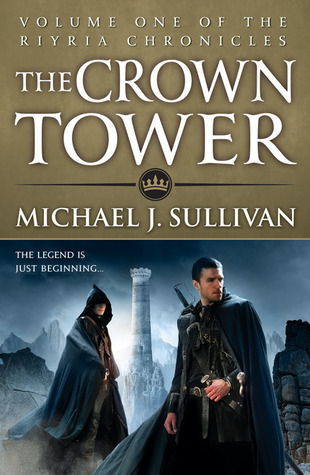
THE CROWN TOWER by MICHAEL J. SULLIVAN

crowntower-2-5

The Crown Tower by Michael J. Sullivan

Genre: Fantasy

Series: The Riyria Chronicles #1

Publisher: Orbit (August 6, 2013)

Length: 416 pages

Author Information: Website | Twitter

My Rating:My rating is 4 out of 5 stars.

For all of you familiar with The Riyria Revelations series, Hadrian Blackwater and Royce Melborn are the dynamic duo of fantasy: Hadrian the great warrior with three swords for any occasion and Royce the dark, mysterious assassin waiting to put a dagger in you. Two partners who are polar opposites in their personality, outlook on life as well as in their fighting styles. No matter their differences, however, these two characters are the most dedicated of partners and friends.

But how could they have ever gotten past these issues to form a partnership called Riyria?

This is the story Michael J. Sullivan sets out to tell in The Crown Tower, and he accomplishes it with a flair long time readers have come to expect from him. The tale he pens is one of those very rare prequels: a stand alone story which – while tipping its hat so subtly to the older novels – never fails to understand it is a story unto itself. Indeed, Hadrian, Royce and Gwen grabbed the readers attention from the first, drawing them along involuntarily in the turbulence of their story as all three are inevitably drawn together.

Naturally, our story takes place before the events of The Theft of Swords, which is the first set of books set in the world of Riyria. Here, Hadrian Blackwater is a young man, still holding onto his youthful naivety yet having seen and done bloody deeds that even he refuses to recall. Our youthful optimist has wandered over half the world since he left his father’s blacksmith shop as a youth, eager to find glory and a worthy cause that his legendary sword skills could be used for, yet none of the glory or gold satisfied Hadrian: they made him feel hollow inside actually. When word of his father’s death reaches him, it is the final straw that breaks Hadrian’s stubborn pride, and he finds himself drawn back to his roots, hoping to find some epiphany about his future: a sign as to what he should do with the remainder of his life – and with his only skill: killing people.

That is where Royce comes in. I cannot tell you how these two meet without giving away spoilers and ruining the surprise, but suffice it to say that Mr. Sullivan crafts this in the perfect way. A set up which not only enlivens what had been a slow story to that point, but also forces our dynamic duo to interact with one another for all our entertainment.

Naturally, after meeting and attempting to clear up their differences, Hadrian and Royce find themselves drawn together whether they like it or not. Their mutual goal to plan and conduct a heist that is so impossible that no one has ever tried it! And that is absolutely insane for two strangers such as them to attempt – especially since they absolutely despise one another!

I know the fact Hadrian and Royce hate one another came as no surprise to anyone right?

Who did not see that coming?

These two are oil and water, even in the later books when they have been partners for years, so most certainly they would not enjoy each others company at first meeting. But Mr. Sullivan does something wonderful in this book: he actually takes the time to explain why each of them behave and believe as they do. He then forces each character to confront those same facts about the other and work through their revulsion of the others’ life view. This sets up interesting and hilarious scenes where Royce and Hadrian are bickering, insulting and threatening to murder one another. They argue about everything, even when death is knocking at their door, and each constantly wonders how someone as idiotic as the other person could have survived so long without someone killing them. They are the only duo since Butch Cassidy and the Sundance Kid I have ever seen carry this type of quarreling and cooperation relationship so far and make this entertaining. (Butch Cassidy and the Sundance Kid is a great, classic western for those who don’t know. Go rent it today and understand what I mean!)

And we cannot forget Gwen, the mysterious brothel owner, who gradually plays a bigger and bigger role in Revelations. Here we get to understand her life up until she met Hadrian and Royce, how she became a prostitute, and the role she played in Hadrian and Royce actually becoming Riyria. While I can’t say Gwen’s story broke new ground in storytelling, it was well written, eye-opening, and added another layer to this elegant lady who always brightened the pages with her appearance in Revelations. For those reasons, it was a very enjoyable part of the overall prequel.

As long time readers already know, Mr. Sullivan has that innate ability to create a page-turner, and The Crown Tower is no different. It is a great read for those who have experienced the wonderful Riyria Revelations and those who have not. The novel has it all: excitement, hilarity, mystery, fighting, and romance. What else could anyone ask for out of a fantasy novel? Nothing. So just go buy the book already, you know you want to.

I received this book as an ARC from Orbit and Netgalley in return for an honest review. The review you have read is my opinion, and mine alone. Royce and Hadrian have not visited me and attempted to bribe or beat me into writing this. And if they had, I doubt I could really mention it so . . .forget I said anything. *Whispering* Royce hears everything.

Buy the novel at Amazon.

Posted in 4 Stars, Fantasy, Swashbuckling | Tagged , , , , , , , , , , | 3 Comments

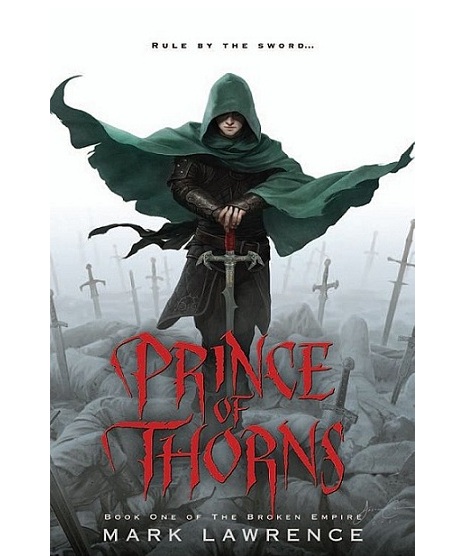
PRINCE OF THORNS (THE BROKEN EMPIRE #1) by MARK LAWRENCE

123455667
Prince of Thorns by Mark Lawrence

Genre: Fantasy – Grimdark

Series: The Broken Empire #1

Publisher: Harper Voyager (April 12, 2012)

Author Information: Website | Twitter

Length: 399 pages

My Rating: 5 out of 5 stars.

I’d heard a lot about Prince of Thorns before I picked it up. Naturally, some of the reviews were positive and some of them were negative. After reading the novel, I can honestly say I understand both points of view, because I found myself mesmerized by Mr. Lawrence’s first-person narrative yet horrified at the person I was reading about. But, beyond any doubt, this is a book that every fantasy fan should read at least once — and many will read over and over again.

The bloody tale spun by Mark Lawrence centers on Jorg Ancrath. A ten year old who flees privilege to grow up with a band of highway men, stealing, raping, torturing, and killing everyone in his path, as he follows a convoluted pathway to revenge. Revenge against the man who killed his mother and brother, but also revenge against the world which has somehow failed him.

Now, Jorg is no hero, nor is he an anti-hero by anyone’s definition. In many reader’s eyes, Jorg will be evil incarnate, though I do not believe he views himself in quite that light himself. No, Jorg seems to picture himself above the petty, frailties of humanity, as if the hook-briars, which gave him his moniker, drained both his blood and his morality away at the same time. This allowed him to see life for what it really is, for as Jorg himself explains:

“When they killed him(Jorg’s brother), Mother wouldn’t hold her peace, so they slit her throat. I was stupid then, being only nine, and I fought to save them both. But the thorns held me tight. I’ve learned to appreciate thorns since. The thorns taught me the game. They let me understand what all those grim and serious men who’ve fought the Hundred War have yet to learn. You can only win the game when you understand that it IS a game. Let a man play chess, and tell him that every pawn is his friend. Let him think both bishops holy. Let him remember happy days in the shadows of his castles. Let him love his queen. Watch him loose them all.”

Life is one huge chess board to Jorg, filled to the brim with pieces he can cast aside as he sees fit. Those you love or care for or feel responsibility toward are merely weaknesses, holding you down. “Anything that you cannot sacrifice pins you. Makes you predictable, makes you weak.” Indeed, to our young Prince of Thorns’ thinking, there is only one expectation placed upon any leader: “not to kill too many of your men. Or who’re you going to lead?” This is Jorg’s world view, which he pursues with a relentlessness seldom seen in fantasy novels.

But he has other endearing qualities though, right?

Nope. Not any that I recall.

In Jorg’s defense, his is an esoteric view of reality, which justifies all his moral faults, because his cruelty and heartlessness are merely the true state of man’s nature, not the lies people tells themselves about honor or love or being a “good man.” (Survival of the fittest on steroids, if you will.) No, those antiquated notions of “civilized” people are the lies . . . the deceptions to Jorg. Only he truly appreciates men and the world they have built for themselves, the untruths people have plastered upon the true face of reality to make themselves feel better. Life is about surviving and obtaining what you desire. The truth is that “pride” is what drives man, makes him reach for something higher than himself, and forces him to sacrifice anyone and everything in order to achieve it.

Jorge explains this view of reality to his peeping toms (readers) throughout the book. His thoughts laying out a framework that points to each man deciding his own fate. No god controls Jorg Ancrath. No divinity or morality defines him. He is a primal force of nature, exhibiting to all around him that man is the god of this world and can live his life however he chooses. The evils, which he metes out against his fellow human, merely an expression of his divine right to set his own rules, master his own fate, and play the game the way it was meant to be played – unless you have the strength to stop him from doing so!

That is the reality Jorg Ancrath demands that you look at and understand. Many times, it seems he is standing over his next victim yelling at the reader to take a good look, because this is what awaits you when you set yourself up as gods. For when every person is their own god and can define their own morality, there is nothing left to stop a Jorg Ancrath except brute force. Might makes right!

Now, it is no easy task to write a character as devious, blood-thirsty and committed to his world view as Jorg. Most times an author who tries, fails due to the believability factor. A few too many rapes or people tortured, and the character ascends into the land of fairy tales, where witches live in ginger bread houses and cook lost children in their ovens. However, Mr. Lawrence never crosses that imaginary line into unbelievability. Jorg’s mixture of philosophical musings and absolute viciousness creates a character who seems as real as Adolf Hitler or Joseph Stalin on a History Channel documentary.

Even the constant flashbacks between present and past Mr. Lawrence uses to tell Jorg’s tale doesn’t detract from this book. Normally, I cannot stand an author jerking me from place to place, and especially from present to past, but here Mr. Lawrence does it so seamlessly that it never disrupts the natural flow of the novel but actually adds another element of enjoyment, as a reader is allowed to put the jig-saw pieces together to understand how Jorg Ancrath became this monster you are reading about.

But the cherry on top of all this is Mr. Lawrence writing slight of hand, as the standard, medieval fantasy setting is turned on its head and turns out to be so much more than a reader initially expected. This mysterious history only adds to one’s desire to explore, discover and learn about this world, which has birthed and nurtured a Prince of Thorns.

Now, there are always thing about a book that do not work no matter how good it is. Prince of Thorns had it share of those like every other novel. I’d feel remiss if I did not point out my few criticism of the novel.

First, Jorg routinely accomplishes physical feats at nine, ten and fourteen that seem impossible. Perhaps I feel this way because I have an 11 year old and 9 year old son, but it is true nonetheless, because no child – no matter how mentally deranged – would have the brute strength to do many of the things Jorg supposedly does when he is so young. Even at fourteen years old, the believability factor of many of Jorg’s physical accomplishments just seems ridiculous.

Two, Jorg’s descent into madness seemed a bit too quick. He is shown as a normal, well-adjusted child of royalty; all the privileges of life accruing to him before his mother and brother’s tragic killings. Hell, he himself says his mother would leave their home before criminals were executed to spare him from such atrocious events. So, I believe it is fair to say Jorg Ancrath was “sheltered” in his world’s context from the true horrors of life. However, our normal, nine year old becomes the poster child for sociopaths everywhere over night basically. It just was too much of a stretch for me, even though I enjoyed reading about it.

Third, Jorg constantly rolls the dice of chance, counting on his deviousness and pure luck to allow him to win every encounter he finds himself in. And throughout the book, he makes wilder and wilder decision; many with no real plan at all, yet it always works out for Jorg. He wins time and again against impossible odds, where no one would have been able to overcome the fundamental difficulties of what he was attempting, but which poses little hindrance to Jorg’s inevitable triumph.

[spoileralert] To those who do not understand what I am referring to, I’ll give one example, though there are many throughout the book. At one point in the tale, Jorg ends up at his childhood home with his father the king, has a confrontation with dear old dad, and is then stabbed by his father. Of course, even though dad wants Jorg dead, he doesn’t kill him or have him killed. Nope, the man who stabbed Jorg has him taken and throw on his mother’s sarcophagus, where he is left to die. Not even a guard to make sure he dies. Nothing like that. Dear old dad just forgets all about his son, whom he wanted dead.

Jorg lays in this state near unto death for days if not weeks until he amazingly recovers. The Prince of Thorns has overcome the laws of nature, recovering from a wound that nearly pierced his heart, overcame dehydration, lack of food for days or weeks, and the onset of infection in said wound, even though he obviously had no medical care. And when he finally awakes, Jorg is seemingly in better shape than one of his companions, who has been imprisoned the whole time but presumably was given food and water occasionally. All this without magic or divine intervention. At least, if either of those had been present, it would have made sense, but as it was written, Jorg is just superhuman I suppose.

Four, Jorg and everyone else in the book are basically not worth killing. No good guys at all here. While it was refreshing to read about a truly evil character like Jorg, I also had nothing to contrast his despicableness against. I personally find it more interesting when there are two sides in a confrontation, where I can “root” for someone. Here, Jorg is basically killing other people who act as viciously as he does or people who happen to be around when he wants to kill someone, so I never really “cared” about the outcome, because I did not have anyone to “root” for or against.

To sum up, other reviewers have hailed Mark Lawrence’s book as “a breath of fresh air in a genre where characters often fall flat.” I won’t go that far, but I will say it is an interesting twist on the traditional, fantasy genre. The story of a sociopath, wielding a sword to destroy his fellow humans while espousing his own brand of morality, was an interesting read. No matter how distasteful Jorg is – and believe me he does not have a single redeeming quality to salvage his soul in this book – you find yourself wanting to read more about his story, hoping that somewhere along the line he has an epiphany that reveals his erroneous morality, or that a true hero shows up and cuts his heart out. Neither happens in this book, but there are two more books to read. Hope springs eternal as the old saying goes.

Buy Prince of Thorns (The Broken Empire Book 1) at Amazon.

Posted in 5 Stars, Fantasy, Grimdark | Tagged , , , , , , , , , , | 28 Comments