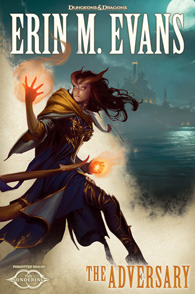
THE ADVERSARY by ERIN M. EVANS

17568783
My rating is 3 out of 5 stars.

In The Adversary, Erin Evans returns to the story of the young tiefling warlock Farideh and her sister Havilar that she began in her two Brimstone Angels books. And while The Adversary is also the third book in the Sundering series, it – like the first two novels of the series – is only loosely connected to the other novels. In fact, the majority of this book takes place about a year after the events in The Godborn, and other than a sense that the Forgotten Realms are continuing to “change,” there is no direct connection to either The Companions or The Godborn, and so there is no need to have read either of those books to enjoy this one.

For those unfamiliar with the Brimstone Angels series, you should know that the main characters,Farideh and Havilar, are the tiefling descendants of one of the most powerful warlocks in history and are viewed as prized possessions by many devils of hell. In the preceding books, this situation has already caused much grief to the sisters as Farideh made a “deal” with a devil named Lorcan, which caused her and her sister to be expelled from their home and have some dangerous adventures. However, during this time, Farideh became friends with and romantically attracted to Lorcan, and Havilar found love with a young man named Brin. So naturally, as The Adversary begins, the relative serenity of the tieflings’ life comes undone.

Worried about the safety of both her sister and Lorcan, Farideh negotiates a deal for ten years protection from the devil Sairche in exchange for two favors. A deal that immediately goes awry for the naive warlock as Sairche keeps her end of the bargain by holding them in statis in Hell for seven and a half years. Everyone Farideh and Havilar know and love believe they are dead.

Once the tieflings reappear in the world, they are not only at one another’s throats due to the loss of nearly a decade of their lives but also because Sairche immediately calls in one of the two favors Farideh owes her. A fact which sends Farideh off by herself to a Netherese interment camp operated by the wizard Adolican Rhand from Lesser Evils, and everyone else wondering what has happened to her.

The tale that Erin Evans pens thereafter is filled with different characters and viewpoints. There is the fierce political machinations between the agents of the Hells, as they try to aid or hinder either the machinations of Shar, Goddess of Loss, or Asmodeus, God of Evil. There is the tale of Farideh and two, undercover Harper agents struggling to undermine their enemies attempt to locate the “Chosen of the Gods” who have some mysterious role to play in the reshaping of the world Faerun. There is the individual stories of Havilar and her old lover Brin trying to see where they stand after seven and a half years have slipped by even as they rush to rescue Farideh. There is the romantic attachment that has grown between Farideh and Lorcan. There is even insight into the tieflings’ adopted father, Mehen, love for his wayward children.

All in all, The Adversary is a wonderful third book in the Brimstone Angels series and a fine addition to the Sundering. While the novel is a bit slow at the beginning, it picks up speed as it progresses to an action packed finale that resolves some mysteries but leaves enough unresolved for more stories about Farideh and Havilar.

Purchase the novel at Amazon.

CHECK OUT MY REVIEWS OF THE SUNDERING SERIES
THE COMPANIONS (THE SUNDERING #1)
THE GODBORN (THE SUNDERING #2)
THE REAVER (THE SUNDERING #4)
THE SENTINEL (THE SUNDERING #5)
THE HERALD (THE SUNDERING #6)

Posted in Fantasy, Forgotten Realms, High, Sword and Sorcery | Tagged , , , | 5 Comments

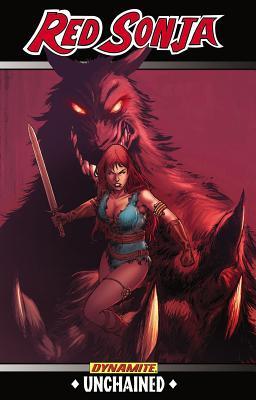
RED SONJA: UNCHAINED

18430208
My rating is 2 of 5 stars.

I recently read Gail Simone and Walter Geovanni’s graphic novel Red Sonja Volume 1: Queen of Plagues and really liked the whole concept, especially how the team turned Sonja from a teenage boy’s chainmail bikini fantasy into a realistic warrior, who just happened to also be an alluring and scantily clad beauty. So when I saw this graphic novel, I really looked forward to reading it, especially since Peter V. Brett had penned this story and I had heard people rave about his fantasy works. Unfortunately, after finishing this tale, all I can say is that Red Sonja: Unchained did not live up to the Simone/Geovanni version and is, at best, just a decent sword and sorcery story.

Here Peter Brett pens an adventure focusing on Sonja rescuing a young man from the clutches of a foul sorcerer in order to get a reward from his mother. Within a few pages, Sonja encounters this nefarious magic user and a demon he has called into the world, beats them down quickly and rescues the enslaved youth from certain death. Afterwards, the young man becomes smitten with his red-haired rescuer and will not take “no” for an answer to his constant romantic propositions. A situation that puts our constantly drunk Sonja on edge. Naturally, there are also supernatural hijinks going on behind the scene, which our red-haired heroine slowly discovers and has to try to deal with. However, even with all this setup by Brett, the story that crystalizes is a very ho-hum sword and sorcery tale that spends far too much time focusing on big “teats”, romance/sex, and Sonja feeling bad about the young man who is determined to force himself on her.

As for the artwork, it is top notch with the segment featuring Walter Geovanni being a real highlight. As I mentioned in my redsonjaunchained1review of Red Sonja Volume 1: Queen of Plagues, Geovanni has really captured Red Sonja and made me view our chainmail bikini red-head as a beautiful but fierce fighter who is more than capable of actually being a formidable warrior. So while Jack Jadson gifts a reader with a beautiful rendition of Red Sonja, it just did not live up to the version envisioned by Geovanni. Even with that being said, however, the art did not detract from my enjoyment of this story.

In summation, this graphic novel was okay. It had above average artwork and a traditional sword and sorcery Red Sonja tale. While Peter Brett’s version of Sonja is not as compelling to me as Gail Simone’s rendition, I still enjoyed the story, but I’m just not sure I will be reading anymore Red Sonja tales penned by Mr. Brett.

I received this book from Netgalley in exchange for a fair and honest review. I’d like to thank Netgalley for allowing me to receive this review copy and inform everyone that the review you have read is my opinion alone.

Purchase this graphic novel at Amazon.

Posted in Graphic Novels, S & S | Tagged , , , , , , , , | 1 Comment

Free books: 100 legal sites to download literature

JustEnglish.me's avatarJust English

The Classics

Browse works by Mark Twain, Joseph Conrad and other famous authors here.

  1. Classic Bookshelf: This site has put classic novels online, from Charles Dickens to Charlotte Bronte.
  2. The Online Books Page: The University of Pennsylvania hosts this book search and database.
  3. Project Gutenberg: This famous site has over 27,000 free books online.
  4. Page by Page Books: Find books by Sir Arthur Conan Doyle and H.G. Wells, as well as speeches from George W. Bush on this site.
  5. Classic Book Library: Genres here include historical fiction, history, science fiction, mystery, romance and children’s literature, but they’re all classics.
  6. Classic Reader: Here you can read Shakespeare, young adult fiction and more.
  7. Read Print: From George Orwell to Alexandre Dumas to George Eliot to Charles Darwin, this online library is stocked with the best classics.
  8. Planet eBook: Download free classic literature titles here…

View original post 1,732 more words

Posted in Lists | Tagged , , , , | Leave a comment

HOPES’ END by BRIAN McCLELLAN

18569078
My rating is 4 out of 5 stars.

“Hope’s End” is a short novella set in Brian McClellan’s Powder Mage world, which began with the novel Promise of Blood. Where Promise was epic in its scale and ambition, depicting vast power struggles between huge forces, sorcerers and demons fulfilling ancient prophesy, and the story of the social and economic cost of a political revolution, “Hope’s End” is a bite-sized snack, allowing a current fan or a newbie reader to experience an exciting snapshot of a soldier’s life in this flintlock and sorcery world.

The story itself shines the spotlight onto one of General Tamas’s soldiers: Captain Verundish. (Yes, you read General Tamas, because this novella takes place before the Powder Mage Trilogy and immediately before Tamas’ ascension to Field Marshall of Adro’s armies.) You see, Captain Verundish is a good soldier: dedicated to her career and to her general, but she has her own personal problems outside of being in harm’s way at all times. One, she is married to a horrid man, whom she wishes to divorce but cannot due to family and religious reasons. Two, she has a young daughter by her foppish husband, and he has threatened to do something awful to this innocent child if Verundish does not give him a divorce – in a very unusual way. And three, General Tamas has placed her lover in command of a Hope’s End: a suicidal attack against a fortification, where her fellow soldiers will be casting themselves into the teeth of both musket fire and sorcery!

How can Captain Verundish save those she loves from such terrible situations without sacrificing herself?

The story that ensues from this setup is all you could ask for from a novella. You get an appearance of General Tamas and a look at his inner motives for future actions. Captain Verundish and her lover are solid characters with real life dilemmas. And there is even a short but exciting battle. At the end, all the problems get neatly resolved.

I have to warn you about one thing though. Once you finish this novella, you will feel it was too short and you will want even more of Mr. McClellan’s Powder Mage universe. But I mean you already knew that right? Why else would Mr. McClellan be giving people such tasty morsels as “Hope’s End” to sample if not to whet their appetite for more? So be prepared to download the author’s other novellas or to buy Promise of Blood immediately after reading this one.

Purchase the novella at Amazon.

Posted in Epic, Fantasy, High, Short Stories | Tagged , , , , , , , , , | 1 Comment

TREBIZOND by NJ HOLMES

18691149
My rating is 2 out of 5 stars.

While it might surprise those who follow me, I really do not like to write tough reviews or give a novel a low star rating. I’d much rather click that 5 star button and crow about a “hidden gem” of a story that I uncovered before anyone else. Sometimes, though, I pick up a novel that screams “This is my kind of book,” and it does not live up to my expectations for whatever reason. Trebizond is one of those books, unfortunately. There was no glaring reason for my apathy toward it. No single cause of my disconnect from it. Nor any misstep by the author which clicked my annoyance button. It was merely one of those instances where it left me saying “so what.”

Trebizond the story is set in the eleventh century A.D. in what historian refer to as the Byzantine Empire. Centered on the impregnable city of Constantinople (today’s Istanbul), the Byzantine Empire was the remnants of the Eastern Roman Empire, which had survived the barbarian hordes that overran the western Roman world. In reality, these people were Greeks, but when the Dark Ages enveloped Europe, they saw themselves as the bearers of the glorious Roman civilization of the past. And when our story takes place, this Romanized Greek empire is still among the greatest powers in Europe; its borders stretching from the Danube in the Balkans to small cities on the Italian Peninsula to northern Syria . But now, there has arrived from the Asian steppes a new nomadic enemy; one who will come close to destroying the Byzantine Empire for good.

NJ Holmes tells of this Turkish invasion through the eyes of three main characters: Theodore Gabras, nobleman of Trebizond, his wife Eirene, and the greatest of the Turkish warlords, Afsin. Overall, the author goes a great job showcasing each person, what they are living through, and then relating that singular experience back to the other two protagonists. Through these different viewpoints, Holmes sets out the story of the gradual destruction of the Empire by its enemies, the Turks own barbaric customs, and Gabras’ slow evolution from man of peace to savior of Trebizond and its rise as the last bastion of Byzantine power in the east.

To be fair, it was obvious that NJ Holmes thoroughly researched this historical epoch, and all the true historical facts are present more or less. At least, I did not spot any variations that were not just artistic liberties to help present an engaging story. And Trebizond was definitely infused with all the ingredients of a good story: political machinations, love triangles, testosterone infused combat, and evolution of characters due to their circumstances. But, even with the table set for a great tale, the actual storytelling failed to produce an emotional response in me. Maybe, it was because the pacing was a little on the slow side. Perhaps, it was the tendency of the author to tell me what was happening rather than show me. Or it could have been because many plot points were not realistically portrayed – at least in my opinion. And while I realize that these issues may sound minor or smack of me being too critical, I have to disagree, because there are times that too many “small” things can ruin a novel. And that is my only explanation for my reaction to this novel.

Now, I can’t deny I’m probably a bit more demanding of historical fiction. It is most likely because of my love for the subject. In college, I was an ancient history major. One of my favorite historical epochs was actually the Byzantine Empire. One of my favorite periods of Byzantine history was the rise of the three successor states of the Byzantine Empire, which included the Empire of Trebizond. Hell, some of my favorite fantasy books are Harry Turtledove’s Videssos series, which is basically a fantasy version of actual Byzantine history. And that might make me judge Trebizond more critically than is fair. But whether that is true or not, this book just wasn’t for me.

In summation, this is okay historical fiction, and it does a decent job of introducing a reader to this period of time and the peoples populating this corner of the globe. While it did not “speak” to me, it might be exactly what someone else would adore. Give it a try and see for yourself.

I received this book from Netgalley in exchange for a fair and honest review. I’d like to thank Netgalley for allowing me to receive this review copy and inform everyone that the review you have read is my opinion alone.

Purchase the novel at Amazon.

Posted in Historical Fiction | Tagged , , , , | Leave a comment

THE DELPHI DECEPTION (THE DELPHI TRILOGY #2) by CHRIS EVERHEART

Delphi DeceptionMy rating is 3 out of 5 stars.

This second installment of The Delphi Trilogy picks up right where The League of Delphi ended. For those who have not read the first novel, here is a brief synopsis of what you missed.

Zach White is your average 16-year-old kid. Just a normal teenager really. He loves his laptop, really digs girls, and has several close friends he adores – even if they are computer hackers. Unfortunately, Zach’s life is not normal, and it has not been normal in a long while.

It didn’t start off this way, you see. As a child, Zach’s life was very normal: mom, dad, school, and friends. He lived in a small town called Arcanville. A town of tidy neatness and polite people. A place with seemingly no crime, filled with homes surrounded by uniform walls and gardens. A hamlet that was more likely to have been the subject of one of Norman Rockwell’s paintings than to be a place he would have to flee from. But once his father died in an airplane crash, Zach and his mother did indeed leave this idyllic local, vanishing into the night, and once they arrived in Europe, his mother had immediately enrolled Zach in a French boarding school under a false name and disappeared, only visiting him sporadically and for short periods of time. Her reason for all this that she was protecting him from the people who were looking for him. People that she could not let find him. These people are why they had left Arcanville. These people were why they had to each live a false life and do without any family. And these people were why he must never ever return to Arcanville no matter what!

Like any good teenager, Zach didn’t understand what was going on with his mother. Oh, she said all this cloak and dagger stuff was for his own protection, but how did he know that was true? Maybe, she had just lost her mind. You heard of it happening. And so when his mother died unexpected, Zach did what any good teenager would do: he ignored her warnings and immediately returned to Arcanville.

Once back in his old hometown, Zach gets a job at the local coffee house and sees that things in Arcanville are stranger than he remembered; an undertone of weirdness permeating the very air. So when a childhood friend commits suicide, Zach begins to investigate. Along the way, he meets a strange girl with mental issues named Ashley, who also believes Arcanville is hiding something sinister. Together, the two find themselves falling in love and rooting out the secrets of this place. And just when they believe they know what is going on, they uncover an even more terrible truth than they had suspected, for Arcanville is part of a world spanning conspiracy! A shadowy tangle of money, power, pharmaceutical experiments, and prophecies so vast that the two of them have no idea what they have stepped into.

It is more than the two teenagers can handle. Soon, they find themselves pursued by people more than willing to kill them for what they know. At least, they are willing to kill Zach, but Ashley is a special case. For you see, the League of Delphi controls the world by knowing what is going to happen in the future. This knowledge provided to them by their Pythia, or oracle, and Ashley has been identified as the next candidate to be the Delphi Pythia! The League will stop at nothing to recover their new priestess!

So as The Delphi Deception begins, Zach and Ashley are in the hospital after a near death escape from police. Unfortunately, Ashley is firmly in control of the League and is in a mental health ward, injected with the drugs necessary to induce her prophecy trance. Zach, on the other hand, finds himself able to escape from the hospital but has no idea what to do now. Should he leave Ashley to her fate or rescue her? And if he tries to rescue her, how can he fight against a world spanning organization more than willing to kill to protect its power?

Like the first installment of this series, I found The Delphi Deception a real page turner. Zach’s continued efforts to uncover his past, unravel the mystery of the League of Delphi, and rescue Ashley kept the story moving along frantically to its cliffhanger ending. In fact, there was never any dull moments in this novel, because Mr. Everheart skillfully interwove secrets of Arcanville and the League together with teenage betrayal and filled other chapters with mysterious prophecies that were never exactly what Zach – or I – thought they were. So a big congratulations to Mr. Everheart for penning such an engaging YA novel without having to resort to anything “fantastical” like vampires, werewolves, or half-bloods.

Naturally, I have to mention those things which I did not enjoy about the novel, so here goes my short list.

As I mentioned in my review of the first book, Zach seems a bit “naive” at times in these books. He is in dangerous circumstances of course, over his head without a doubt, but even taking this into consideration, he does things which make you scratch your head and think “He is really going to do this. This is stupid.” And it was not a single time or even two that I felt this way but over and over again. Like I said, I understand he is a kid dealing with a situation he is incapable of handling, but I would have expected a bit more wisdom on his part, especially since the first book described him as a street suave, young man.

My second complaint is that The Delphi Deception takes place in the same location as the first, and while Mr. Everheart does his best to introduce new situations and places, he is forced to plow back over freshly tilled soil by revisiting the same locations and same issues. While this is not necessarily a bad thing, it was just difficult to read about Zach and his new sidekick doing the same things that he and Ashley did in the first book. “We have already been there and done that, give me something new” is what I was thinking at times.

Even with those issues, however, The Delphi Deception is a very good novel, and I can’t wait to see where Mr. Everheart goes with the series.

I received this book from Netgalley in exchange for a fair and honest review. I’d like to thank Netgalley for allowing me to receive this review copy and inform everyone that the review you have read is my opinion alone.

Buy The Delphi Deception: Book II of the Delphi Trilogy at Amazon.

See my reviews of the trilogy.
The League of Delphi Book #1
The Delphi Revelation Book #3

Posted in Young Adult | Tagged , , , , , , | 3 Comments

THE GARDEN OF STONES (PART 1 OF ECHOES OF EMPIRE) by MARK T. BARNES

17046606
My rating is 3 out of 5 stars.

The Garden of Stones is the first installment in the Echoes of Empire fantasy series by Mark T. Barnes, and it is quite simply a spectacular concoction imbued with potential brilliance.

From the very first page of this epic, Mr. Barnes immerses his first time reader in a world filled with vivid cultures, unusual species, ancient mysteries, and complex characters. Through beautifully worded descriptions, he unveils an original fantasy landscape, filled with amazing details. A land so richly-imagined and so complex, drawing on concepts and imagery that are so fresh and original, that a casual reader may find themselves caught up in the deluge of fantastical races, names, and places and begin to flounder in this sweeping tide. However, if you can fight against the surge of information and steady yourself by latching onto and constantly referring to the glossary, you will bob to the surface and settle down into a steady rhythm of reading and glossary checking. Once this equilibrium has began, the story that Mr. Barnes pens will quickly carry you away.

The tale itself is set in Shrian, a civilization dominated by a diverse ecosystem of peoples. At the top of the peeking order are two non-humans races called the Seethe and the Avan. The Seethe, or Wind-Masters, have feathers in place of their hair and are the “creators” of the Avan, who were designed to be the Seethe’s servants but ultimately became their masters. Joining these two races upon the world stage are many unique and varied creatures including the Iphyri “giant men with the heads, legs, and tails of horses,” Wyvern riders, Tau-se (lion-like people), and Fenlings, who reminded me a great deal of Warhammer’s Skaven. The newcomer to this diverse environment is Man, who arrived from the stars in their ships long ago.

Among the Shrian culture, there is no shortage of “magic” though it is not the type most fantasy readers are accustom to. Here it is labeled “disentropy” and is described as “the energy of creation generated by all living things, eddied and swirling” within the air itself. But more than that, the users of disentropy are described as using “numbers” cascading through their mind to create three dimensional image as they attempt to influence the worldly elements and string together form from chaos. A description that reminded me more of the “force” in Star Wars than any magic system I’ve encountered in fantasy literature. But the magical wonders do not stop with disentropy itself, because Mr. Barnes unveils mighty machines such as flying ships, time portals, cloning engines, rifle-like guns, and other marvels of a highly advanced technology. Technology that was developed and partially lost in cataclysmic events of the past.

This lost past opens up yet another avenue for Mr. Barnes to world build, as he slowly reveals an extensive and elaborate history. A past which stretches out thousands and thousands of years behind these people, filled with world-spanning empires, cataclysmic events, forgotten technologies, eternal spirits, and ancient enmities. Enmities that are still at play in the current world, fueled by the Great Houses of nobility who via with one another for power and fan the flames of ancient grudges. This world building setting in place a combustible mixture ripe for an epic explosion of conflict and adventure.

A reader’s tour guides through this epic world are no less interesting than the land upon which they reside. The central character is Indris, called “Dragon-Eyed.” He is a prince from the Great House of Nasarat and a former knight of the Seq Order of Scholars. Though among the mighty of the warrior-poets, he abandoned his calling to marry the woman he loved only to loose her. Now, still grieving from her presumed death, he has become a daimahjin (a mercenary warrior-mage) and come to Amnon to aid his father-in-law, Rahn Far-ad-din, who is beset by political machinations at their finest.

The diabolical instigator of Indris’ problems is one Corajidin, who is the leader of the Great House of Erebus in the Shrianese Federation. Although he is losing hold of sanity and more than likely dying, Corajidin will not relinquish power but wishes to fulfill a prophecy he was given, believing that he is destined to be the next Asrahn (High King) of Shrian, Ruler of all the Great Houses belonging to the Federation. All that stands between him and his desire is Far-ad-din, Indris, and his growing insanity.

To further complicate things, we have a forbidden relationship between Indris and Corajidin’s daughter, Mariam “Queen of Swords,”which forces her to make an impossible decision to aid her father or her lover.

From all these different ingredients, Mr. Barnes serves up a fantasy feast of epic proportions. No one beginning this novel should view it as anything resembling a fast, casual read, but undertake it as if you were beginning The Wheel of Time, The Malazan series or A Song of Fire and Ice. Also, please understand that this is no YA novel but an adult one. Throughout this story, Mr. Barnes tells his story through multiple points of view; there is political intrigue resembling a game-within-a-game chess match; sexual situations do get explored; violence and bloody mayhem rule the day many chapters; and there is lots of grey morality exhibited by both the “good guys” and the “bad guys.” If all of that sounds good to you then this is an epic fantasy you must read.

Having said all of this, I want to explain why I only gave this book 3 stars, which in my rating system means that I “liked” the book.

Quite simply, the pacing of the story was too slow for me. While I understand that Mr. Barnes had to accomplish a massive amount of world building to setup the actual plot, it still doesn’t excuse the plodding nature of much of the narrative. This story just crawled at times. And the big showdown between Indris and Corajidin, which is set up and begins to build from the first page, was unnecessarily delayed by minor subplots. I have no problem with there being numerous subplots going on in an “epic” novel like this, but these side issues should either buildup the final showdown or be more in the nature of foreshadowing future events. Here we had unimportant – at least in this novel – characters taking up massive amounts of time for no apparent reason. Later in the series, Mr. Barnes may show me the error of my assumptions, but as of right now, I do not understand what the point was for them and view them as filler material.

Other than this one complaint, I enjoyed The Garden of Stones. It was a fresh, original approach to epic fantasy. Sure it appears to borrow a few concepts from other fictional works, but Mr. Barnes does a great job of incorporating enough new ideas to make this no copycat work. Plus, I absolutely loved the twist at the end of the book and can’t wait to see what happens with Indris going forward.

Netgalley provided this book to me for free in return for an honest review. The review above was not paid for or influenced in any way by any person, entity or organization, but is my own personal opinions.

Purchase this novel at Amazon.

BE SURE TO CHECK OUT MY OTHER REVIEWS OF THIS SERIES
THE OBSIDIAN HEART
THE PILLARS OF SAND

MARK T BARNES INTERVIEWS AND GUEST POSTS
ANNE CHARNOCK
SUZANNE CHURCH
THE SCIFI SHOW

UPCOMING4

Posted in Epic, Fantasy, High, Sword and Sorcery | Tagged , , , , , | 9 Comments

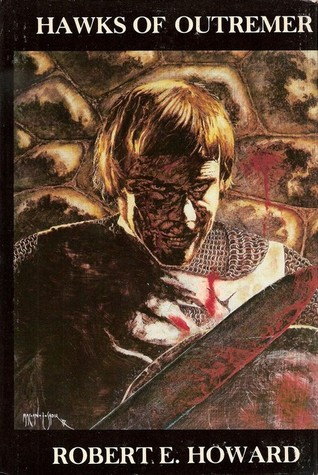
Hawks of Outremer by Robert E. Howard

4413616
Hawks of Outremer by Robert E. Howard

Genre: Historical Fiction — Medieval Crusades

Series: Stand Alone Novel

Publisher: Donald M. Grant Publishers (1979)

Length: 165 pages

My Rating: 3 out of 5 stars.

Robert E. Howard was one of those prolific writers that could churn out stories, characters, and ideas seemingly at will. In just 10 years, he penned approximately 300 short stories, two novels and countless poems featuring numerous characters in a wide variety of genres, including heroic fantasy, western, horror, historical and humor. Without a doubt, Conan the Barbarian is the most famous of his creations, but his stable of protagonists span the gamut from Sailor Steve Costigan, 1930s tough guy sailor, to Dark Agnes de Chestillon, red-haired 16th century French swordswoman, and include such notable heroes as Soloman Kane, El Borak, De Montour, Kull the Conqueror, and Bran Mak Morn, last king of the Picts. One character who is usually not listed among Howard’s famous characters is the half-Norman, half-Gael knight named Cormac Fitzgeoffrey, but just like his more famous siblings, Cormac is yet another sword wielding man who is hard as nails.

In the Hawks of Outremer, Howard gives a reader a series of stories set in the Holy Land at the time of the Third Crusade. Cormac Fitzgeoffrey of Ireland has accompanied the armies of Richard I, King of England, nicknamed “Coeur de Lion” or “Richard the Lionheart” to Palestine to vanquish the hated infidels of Saladin and recover Jerusalem for Catholic Europe. But while Cormac nominally rides under the banner of King Richard, he is a man who recognizes no one as his king, owes allegiance to no man and follows his own personal sense of honor – especially toward his friends. And – like most Howard characters – he is a man of strength – both physically and mentally – and one who has a deep belief in personal justice, or vengeance for any slight. Plus, Cormac feels like an outsider to the civilized world, seeing in himself a superior breed of natural man; one whose inherent superiority is shown by his ability to kill/maim those weaker in spirit and physical strength than himself.

The story itself begins in earnest when one of Cormac’s friends is killed at the border of Muslim controlled territory in the Holy Land. Naturally, our hero decides that such a heinous crime cannot go unpunished and decides to avenge his friend. So as not to incite any renewed hostility between the Christians and Muslim states, Cormac goes alone to exact vengeance. Typical Howard swashbuckling ensues thereafter.

The book also contains two other short stories involving Cormac, albeit in different yet similar adventures. No need to describe the actual action: it is more of the same. In fact, one of these tales was changed a bit to make it into a Conan adventure by writer, Roy Thomas, back in the day.

Overall, this book is a typical Howard testosterone feast. Nothing deeply philosophical here that I caught, but it is worth a read if you are a Howard completionist or just want something to pass the time away. Since I found this book online for free and tend to enjoy anything Howard writes, I probably enjoyed it more than I would have otherwise.

Purchase the novel at Amazon.

Comment Comment | Permalink

Posted in 3 Stars, Historical Fiction, Swashbuckling | Tagged , , , , , , , | Leave a comment

PAWN OF PROPHECY by DAVID EDDINGS

651240My rating is 5 out of 5 stars.

There is nothing I hate more than trying to review one of my all-time favorite books from my teenage years. We all know the reason: the book just never lives up to your memories of its perfection. A fact – which if we are honest with ourselves – is inevitable, because we personally have changed too much, the world has changed too much, and our tastes have changed too much since the initial reading. This is true to a certain extent with David Edding’s Pawn of Prophecy.

Back when I picked up this first novel of The Belgariad in 1984, I was a 13-year-old or a 14-year-old (I can’t remember which anymore) just getting over an addiction to Dungeon & Dragons and trying to transition away from my pre-teen persona into my young adult one. I had also just recently made the life altering discovery of J.R.R. Tolkien, whose books made me fall in love with fantasy and ruined my dreams of ever being considered a cool kid in high school. (It was hard to be cool when you were reading The Hobbit and making jokes about what exactly JRR was talking about when he wrote “…it was a hobbit-hole, and that means comfort”, but I probably shouldn’t really mention that in this review.) So when Pawn of Prophecy found its way into my hands, it must have been fate, and I fell very hard for all things related to Belgarath, Polgara or Garion. A love which lasted into my early twenties and began from the very first page of this novel.

As a teen who adored the Council of Elrond chapter in The Fellowship of the Ring, the prologue to Pawn of Prophecy was like getting a fix of my favorite pharmaceutical product. Where else except for The Silmarillion could I get to read about ancient gods creating a world only to have its perfection marred by some horrible act and throw creation into a state of constant strife? Not too many places. So within minutes, I was addicted to this story of maimed Torak and his eternal conflict with his godly siblings over possession of the Orb of Aldur, and I had to have more. Honestly, it was just a great hook.

From this beginning, Mr. Eddings immediately thrust me into the story of a simple farm boy named Garion. I learned of his earliest memories, hiding under a table watching his Aunt Pol cook. I experienced him growing up with his childhood friends, playing games, and even saw his first romance between himself and a local girl Zubrette. I also read about – but payed little attention to – the introduction of a wandering storyteller named Mister Wolf, who seemed like the comic relief more than a major character. (Boy, was I wrong on that!) And like all good fantasy books, Mr. Eddings provided me with constant foreshadowing that there was some terrible evil lurking right around the corner, waiting to destroy all this normalcy. A feeling which he deftly stoked by scene after scene of Garion experiencing visions of an unknown antagonist stalking him.

Naturally, one day Garion’s quiet farm life did end and end suddenly. Mister Wolf arriving at the farm unexpectedly, bearing news that a mysterious object has been stolen by a thief whom no-one will name. This news shocks Aunt Pol, causing her to pack up her and Garion’s things and leave the farm with Mister Wolf, dragging our clueless teenager along against his will. From there the true adventures began, and what a tale it was!

A huge, colorful world inhabited by different cultures, grand characters, and even ancient gods opened up before Garion. All of it there for our young farm boy to see and experience and me tagging along behind. Mr. Eddings dazzled both of us with his constant unveiling of ancient mysteries, evil villains, grand conspiracies, divine prophecies, and wonderful history. And the whole time, I – a teenager myself – witnessed one more thing: Garion dealing with the normal teen angst of a simple boy ripped from his safe home and thrown into a larger, more dangerous world than he ever imagined. Every adventure, every heartbreak he experienced slowly turning him into a young man before my reading eyes. Something that I was also struggling with in my own life though in different ways.

It was a grand ride that Mr. Eddings took my teenage self on during those years, and I adored every one – even when I was 19 instead of a 13-year-old, because for a few hours I could go back “home” and visit my teen heroes Garion, Belgarath, Aunt Pol, Silk, and all the rest. They felt like family to me. And it all started with this book.

Later in life I returned to Pawn of Prophecy to revisit my old “friends.” Like many times when you visit your childhood haunts, I found that things had changed – specifically me. I was older. No doubt about that. The mirror doesn’t lie after all. Plus, I was a father now. Responsibilities and all that other grown up stuff weighing me down. And I have to admit that I was now a bit jaded about life. Things were more gray now and a lot less black and white than back in my teen years. So Pawn of Prophecy’s straightforward fantasy about good guys defeating bad guys did not energize me as much as it once did. The best comparison I can give is going to your twentieth high school reunion excited to see your old girlfriend/boyfriend only to realize they aren’t sixteen anymore, have put on thirty pounds and gotten wrinkles just like you. How dare they change! That is how I felt as I sat there reading about my old friends Garion, Belgarath, and Polgara.

So why the five (5) star rating if I felt this way on my re-read you ask?

Simple: I try to rate my favorite, childhood books by what I thought of them when I read them the first time.

Maybe rating certain novels that way is wrong, but I cannot think of another way to be fair to a novel which I dearly loved at an earlier period of my life. It isn’t the books fault that I have gotten old after all. And the truth of the matter is that when I read Pawn of Prophecy – not once but numerous times in the 80s – I absolutely loved it! The simple plot and world spanning journeys of Garion bedazzled me, making me want more and more, and in my obviously biased opinion, it is still a great book for the right person – maybe another 13-year-old boy trying to grow up. Because I truly believe that even in its simplicity Pawn of Prophecy can still speak to that person and begin them on their journey into the world of fantasy novels. For that reason – and all my personal memories of it – Pawn of Prophecy will always remain a 5 star book and one of my all-time favorite fantasy novels.

Purchase the novel at Amazon.

Posted in Epic, Fantasy, High, Young Adult | Tagged , , , , , | 5 Comments

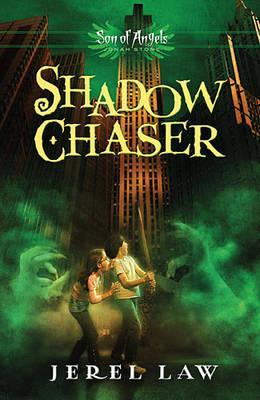
SHADOW CHASER by JEREL LAW

16287338
My rating is 2 out of 5 stars.

Shadow Chaser is the third book in the Jonah Stone, Son of Angels young adult’s book series by Jerel Law. This novel is unapologetically Christian in nature and also in its hero’s resemblance to one Percy Jackson. If you are either a follower of Jesus Christ or a lover of half-blood heroes then you might enjoy this YA story of modern day, angelic conflict and Godly messages.

The world of Son of Angels is basically the modern day. In the preceding installments of the series, Mr. Law introduced Jonah Stone: a teenager who is the son of a minister and unbeknownst to him a “Quarterling” because his mother is half angel, or a nephilim. The revelation of his true nature is unbelievable to Jonah and so is his discovery that the earth is still the center of a great conflict between the angels of God, or Elohim, and the fallen angels of Satan, or Abaddon. A conflict which is unknowingly raging around the world as these spiritual beings fight in a dimension encompassing our own.

Naturally, the discovery of another quarterling draws the attention of not only the “good” angels but also the “bad” angels, who wish to either turn Jonah to Abaddon or kill him. Demons therefore begin to attack not only Jonah but his family and friends as well, so he – like all other quarterlings – is encouraged by the angelic hosts to attend a special “school” in New York City, where he will be trained to defend himself from the constant attacks (both physical and spiritual) of these fallen angels.

With that back story out of the way, we now turn to Shadow Chaser.

Jonah and his two siblings are safely ensconced in the Angel Academy for training. Jonah himself has been doing well, growing in his angelic powers and trying to cope with his newly discovered gift of prophecy, but he has a lot on his plate: not only is he still expected to master a “normal” education but an angelic one as well. Plus, let us not forget that Jonah is still a teenager; one who seems especially hard hit by the onset of acne. These teenage blemishes cause him both physical pain (they later turn into really painful sores) but also makes him the butt of everyone’s cafeteria joke and quickly turns our pizza face teenager into a social outcast. But the fun doesn’t stop there because it is time for angelic testing, which means Jonah finds himself competing against a few other students who have become his “rivals” for best quarterling at the school.

The story that ensues from this setup is an engaging one. Plagued by intense visions and actual pestilence, our young quarterling embarks on his own inner journey for understanding and peace, dismayed by the sickness that invades his body and the turmoil raging in his pubescent soul. Soon, the story turns into a modern day (though watered down for 8-12 year olds) version of the Biblical story of Job, and Jonah has to decide whether to place his trust and faith in Elohim (God) or throw in his lot with Abaddon (Satan). It is a life changing decision that our young hero faces.

After finishing this story, I have to admit that I liked Jonah. He reminded me a lot of Percy Jackson. (Please remember imitation is the sincerest form of flattery.) Our young quarterling is confused, dense to most everything around him, committed to his family and friends, and sincerely wants to do the right thing. However, just like Percy, Jonah is having a hard time finding the right combination of youthful enthusiasm, godly ability, and hard-earned wisdom to actually make the correct decisions. But while he may annoy a reader with his cluelessness, Jonah always comes through when he needs to and saves the day. What else could anyone ask for in a YA hero?

Outside of Jonah, however, I have to point out that this book had some issues. Issues which affected my ability to enjoy this very compelling story as much as I otherwise would have. The three main problems are as follows:

1) The rhythm of the storytelling was a bit inconsistent. We all know life is like a roller coaster: big ups then big downs, but spaced between these highs and lowers are times of normalcy. In Shadow Chaser, there never seemed to be any of those regular moments. One minute Jonah would be having a huge fight with evil fallen angels then he would be over in a corner in the cafeteria having an emotional meltdown because his acne had gotten worse or his friends were making fun of him. While I realize that is very teenage-like behavior, there was too much of this up and down behavior and not enough normalcy for my tastes.

2) There was no real mystery in this book. One thing Rick Riordan did an amazing job of in Percy Jackson was to keep leading a reader around through repetitive quests while promising a big payoff; the payoff being the answer to a prophecy or the reveal of the “bad guy” or whatever. Even when these reveals were not earthshattering, they still gave a reader a feeling of reward for reading yet another installment of Percy’s story. In Shadow Chaser, there was no real mystery for Jonah and the Quarterlings to solve, since you already know that Abaddon is behind everything.

3) While the supernatural world of the angels of Elohim are mentioned numerous times throughout the book, a reader never learns much about them. In fact, the angels are written in such a way that they seem much like any other teacher or military instruction in the real world and their otherworldly dimension just an invisible New York City. I personally would have loved Mr. Law to have fleshed these divine creatures and their spiritual world out in all their supernatural glory, making me sit in silence as I read about the divine splendor of it all, but instead I found myself told over and over again that this person – who acted like and talked like any other person – was a divine and glorious angel. That did not work for me.

All in all, this was an interesting book. It leaned heavily upon the Christian Bible and little know sections of that work, and it was also unabashedly a morality play for a Christian YA audience. However, Mr. Law added in enough action with quarterlings fighting fallen angels or quarterlings vs. quarterlings during their Angel Academy mid-term exams that things never got dull. So, for someone looking for a Christian version of Percy Jackson, this is a good read, but I can see where it might not appeal to everyone.

Netgalley provided this book to me for free in return for an honest review. The review above was not paid for or influenced in any way by any person, entity or organization, but is my own personal opinions.

Purchase the novel at Amazon.

Posted in Christian, Young Adult | Tagged , , , , , , , | 1 Comment