LIBERTY: 1784

18143930
Liberty: 1784 by Robert Conroy

Genre: Alternate History

Series: Stand Alone Novel

Publisher: Baen Books (March 4, 2014)

Length: 368 pages

My Rating: 3 out of 5 stars.

After reading Mr. Conroy’s extremely entertaining alternative history book 1920: America’s Great War, I had high hopes for this novel. Not only did it seem to have an interesting premise regarding “what if” the British had won the American Revolution, but it also promised to delve into the idea of how would liberty survive in a conquered country that has lost its greatest leaders. This intriguing alternative world coupled with the author’s proven ability to write an easily digested, fast-paced, and exciting narrative seemed to make this book a can’t miss for me. However, for reasons I will outline later, Liberty: 1784 was a disappointment.

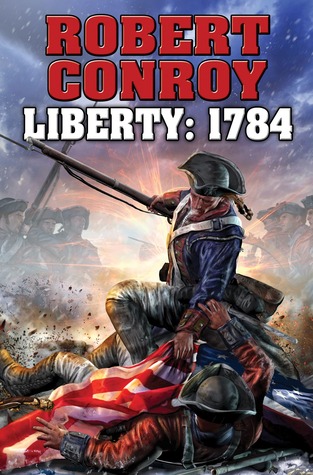
The whole concept of this book revolves around one simple change in history, specifically who won the Battle of the Capes in 1781. In real history, the French fleet won said naval battle, turning back the British relief ships sent to aid General Cornwallis. As Michael Lewis, the author of The History of the British Navy, puts it: “The Battle of Chesapeake Bay [alternately known as the Battle of the Capes] was one of the decisive battles of the world. Before it, the creation of the United States of America was possible; after it, it was certain.” However, in Liberty: 1784, history has been turned upside down, and the victorious British navy brings relief to Cornwallis’ army, allowing him to win the Battle of Yorktown and thus the war.

From this starting point, Mr. Conroy crafts an eerily similar but far different America. One in which the colonies’ unconditionally surrender to Britain. The people are adrift, bereft of their leaders, as the Founding Fathers are either imprisoned or sent to London to be beheaded before a vengeful King George. From northern Massachusetts to Georgia, the land is an occupied territory, governed by General Cornwallis and the cities controlled by his victorious army. Freedom is something that is not openly spoken of, for fear of being further tormented by loyalist cronies of the Crown. In fact, things are so bleak that people begin to abandon their homes and farms to disappear into the west. Rumors say these travelers are heading to sanctuary. A place where the few remaining American leaders have fled into exile with a remnant of the Continental Army, there to create a new country in the continental interior. A land of freedom that is known only as Liberty!

At first, the British care little if American malcontents vanishing into the endless forests of the interior. Good riddance! But then a European spark ignites the powder keg that the American peace rests upon: the French Revolution. This savage uprising against the French monarchy sends King Louis XVI and Queen Marie Antoinette fleeing to England, where King George grants them refuge and determines to put an end to the revolutionary spirit that is spreading across the world like a plague. Thus, the enraged monarch sends an army to France but also dispatches another to America; the western force tasked with finding and destroying the final bastion of liberty on the North American continent!

The story that follows is interesting enough, especially how Mr. Conroy gives a reader numerous viewpoint characters – both historically significant and totally fictional – to see all sides of the conflict. Everyday men and women play major roles in the action along side famous names such as Benjamin Franklin, Lord Cornwallis, Benedict Arnold, and the villainous Banastre Tarleton (most well known for his role as Mel Gibson’s adversary in the movie The Patriot.) Each character’s story blends with the others to form a top to bottom picture of this desperate battle for liberty. Yet, even with this said, there were major problems with Liberty:1784 that I will briefly touch upon.

1) Too much sex. I am not a prude. I’m fine with sex that moves the story along. I realize that hundred of years ago people had sex. However, in this book, it seemed like all the female characters were either being forced to perform sexual acts, getting raped or pulling up their skirts and mounting their men quite a lot. So much so that it detracted from the main story, which was a desperate struggle for survival and the future of the American colonies.

2) Too modern in tone. After reading 1920: America’s Great War, I knew that this novel would not accurately reflect the language, culture and social norms of eighteenth century America and Britain, so it did not surprise me when the characters spoke in a modern, twenty-first century voice. However, the language was so modern in this novel that it became totally unbelievable. We have women saying things like “Fairer and weaker sex my ass.” We have men and women talking about social issues like they are drinking coffee in a local Starbucks. Honestly, it was hard to maintain the belief that these people were living in the 1700s with the language being so modern and their outlook on life so present day in tone.

3) Farfetched history. Even though Mr. Conroy’s alternate world was somewhat plausible, it took too many leaps of faith to believe this type of story would have ever happened. I’ll try to point out a few without ruining the book for anyone.

A) Conroy has a trickle of American revolutionaries setting up a new country in the heart of Native American country without any alliance with or problems from the tribes. It would seem that the natives should play a huge role in the story, but they are only minimally involved.

B) The French Revolution erupts earlier than in our real history and occurs even though the democratic movement of the time has been dealt a huge defeat by the British winning the American Revolution. Really?

C) When the revolution breaks out, Louis XVI takes refuge in England? It doesn’t make much sense, since in real world history the French royals attempted to escape to the Queen’s family in Austria.

D) After taking in the French monarchy, King George decides to join an alliance of the European aristocracy to retaking France, but he then immediately decides to split his forces, because he has to destroy a small frontier town in America that is hoping to “hide” from the British military? Just cannot see where Britain would be concerned enough to send an army.

All in all, Liberty: 1784 was an okay read; it was well-paced, fun in many parts and had enough twists and turns to keep a reader from focusing on the fact that you know the good guys (Americans) are going to win no matter what happens. Mr. Conroy also must be given credit for going out of his way to focus on several female characters and give women the page time that they deserve in this type of novel. However, this book just did not live up to my high expectations for it, so for that reason, it was a disappointment to me. Do not take this to mean I am abandoning any further reading of Mr. Conroy though, because nothing could be further from the truth. In fact, I look forward to enjoying more from him in the future and would encourage you to give him a try as well.

The publisher provided this book to me for free in return for an honest review. The review above was not paid for or influenced in any way by any person, entity or organization, but is my own personal opinions.

Purchase this novel at Amazon.

Posted in 3 Stars, Alternative History | Tagged , , , , , , , , , , | 2 Comments

Grimm Fairy Tales: Oz

18767261
My rating is 2 out of 5 stars.

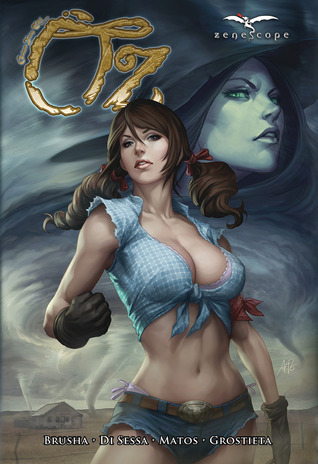
Grimm Fairy Tales: Oz is yet another re-imagining of a classic fairy tale from the people who have brought us Wonderland and the fairy tale superheroes of The Realm Knights. Since I really enjoyed those two series, I decided to snatch this one up and keep my fingers crossed that Joe Brusha could make some magic in Oz. And while he does his best to take the classic Wizard of Oz story, setting, and characters, stuff them all in a blender and pour out something with a whole new flavor, Mr. Brusha fails to fully deliver in this collection.

The beginning of our story is basically the same setup we have all heard before: Dorothy Gale lives on a farm, gets sucked into Oz by a tornado and accidently kills one of the wicked witches with her house. However, from there the story changes, as there are no magic slippers or need to follow the yellow brick road to see the “wizard.” Nope, here Dorothy has fallen into a war between the good witches and the bad, which she immediately becomes sucked into, and once firmly entrenched on the side of the good witch Glinda, Dorothy never looks back but follows a course that leads to a journey around Oz, a few fights with the wicked witch, picking up a number of familiar friends, and eventually returning to Kansas. All in all, not that much different from the classic story.

Well, to be fair, there are differences in this graphic novel. Dorothy’s friends are changed in numerous ways. Some of them for the better. Some for the worst. Most of it is in their back story, but a lot of it is their looks, which – while interesting to view – did little to make the characters more engaging. Honestly, I really could not see that the Grimm Fairy Tale versions of Dorothy’s friends grew and changed much at all in this story. At the end, they are basically the same people as when Dorothy first encounters them.

And you know, I’m sorry I even mentioned the ending, because I really do not even wish to think about it anymore. Let us just say it was abrupt and not very well done and leave it at that. If I explained further, I would be keeping you from experiencing the frustration of it all.

As for the artwork in Oz, I can’t complain. It is very serviceable and fits the mood and tone of the book as a whole. I’ve read other reviewers criticizing the lack of clothing on the female characters, and while I generally don’t mind seeing scantily clad women, I have to agree with the criticism here. Dorothy and the wicked witches’ clothes (or lack thereof) were really over-the-top and somewhat silly. Honestly, if you were Dorothy and you were going into battle, would you be wearing a miniskirt and a mid-drift shirt? Probably not, and it would have helped the story if she had armor on and reverted to her sexy outfit later. Walter Geovanni does this all the time on Red Sonja, and it never disrupts the story.

Overall, I mildly enjoyed this graphic novel – though not as much as I have other Grimm Fairy Tale stories. The artwork was well done and more than capably moved the story along, and even if the story was the same old Oz, at least the re-imagination of Toto, Scarecrow, Tin Man, and the Cowardly Lion were inventive touches. I doubt I’ll be going out to buy this one, but it was still well worth a read. Give it a try.

Netgalley provided this book to me for free in return for an honest review. The review above was not paid for or influenced in any way by any person, entity or organization, but is my own personal opinions.

Purchase the graphic novel at Amazon.

Posted in Graphic Novels, Grimm Fairy Tales | Tagged , , , , , , , , , , | 7 Comments

1920: AMERICA’S GREAT WAR

17571484
1920: America’s Great War by Robert Conroy

Genre: Alternate History

Series: Stand Alone Novel

Publisher: Baen Books (December 3, 2013)

Length: 354 pages

My Rating: 4 out of 5 stars.

1920: America’s Great War is alternate history at its best. It is fast. It’s fun. It doesn’t take itself too seriously. Nor does it pretend to give you a history lesson in disguise. Nope, Robert Conroy has written a real page-turner with interesting characters and an engrossing plot that does a great job of doing just what it is suppose to do: entertain its reader!

In this alternative world, the Great War in Europe, or World War I as it is now dubbed, lasts only a few months, as the French do not halt the German army at the Battle of the Marne but are instead given a final defeat that leads to their surrender. Thereafter, the British Expeditionary Force attempts to fight its way to the Mediterranean coast and escape by sea, but they are cornered and brought to heel in southern France. A triumphant Germany then goes on to obliterating the armies of the Tsar of Russia, resulting in a peace treaty that leaves Germany as the supreme power on the European continent and gifts her with even more overseas colonies. The German Empire is now the preeminent power in the world and is supreme everywhere! Well, maybe not on the high seas, because the British Navy still rules there, but the German Navy will deal with the Brits soon enough.

At this point in time, the U.S. is in pretty pathetic shape. She never involved herself in the European conflict, and so her army and navy are almost non-existence. She has a pacifistic President in Woodrow Wilson, who has reduced the armed forces and sincerely believes that there will be no more wars and that peace will now reign eternally. And even when Germany involves itself in a revolution in Mexico and sends troops there, the United States still clings to its belief that the peace between herself and Germany will last forever.

Naturally, President Wilson and the other appeasers are dead wrong on the Kaiser’s intentions in North America. (I mean, otherwise, there would not be a book, right?) For the ruler of Germany is growing older and he is determined to leave to his heir a world dominated by Germany and without fear of any potential rivals, and the Kaiser clearly envisions that the United States – if awoken – has the hidden seed of a superpower within her pathetic breast. A power that could very well upset this new Pax Germanica. And the Kaiser is determined to stop this threat before it ever rears its ugly head!

The stage is set for a fun-filled alternative history tale!

And boy, does Mr. Conroy deliver.

You want political intrigue between nations? They are here.

You’d like to sit in on desperate military commanders trying to slow down an overwhelming attack? Come on in.

The horrible realities of civilians caught in a war? They are touched upon without being too realistic for this type of story.

Naval battles? Check.

Famous people from history making appearances? No problem.

Honestly, 1920: America’s Great War is a very accessible and readable story. Its characters – while generally one dimensional – are plausible, easy to root for or against, and compliment one another, while the historical world they inhabit is genuine enough that the tale never seems too “far-fetched.” Like all novels, however, I found a few things that I wish would have been handled better by the author, and I cannot help but list them – though I promise to be brief.

1) As many other reviewers have pointed out, Mr. Conroy takes many liberties with the historical facts of this time period. Certain equipment that play major roles in this story was not “invented” until later on in World War I, and since in this alternative world, WWI only lasted a few months, those aircraft, tanks, et cetera would not have even existed for use in a German-American War. Also, many of the armaments and fortifications that the U.S. did have in 1920 are omitted to make the U.S.’s position even more pathetic than it really ways. And Germany’s ability (financially/logistically) and its desire to wage a war half a world away in North America is doubtful at best.

2) Everyone in the novel basically talks like they are living around the corner from the author in twenty-first century America. Oh, there might be a few figures of speech from the early twentieth century, but overall, Mr. Conroy does not attempt to mimic the culture or speaking styles of this period of history. So if you are looking for a novel that has the “look” and “feel” of 1920’s America or Germany, this is not the book for you.

Other than these “historical” criticism, I found 1920: America’s Great War a fascinating novel and an excellent read. Mr. Conroy’s obvious love of history comes across in this story, and while he has altered the facts to his liking, he has done so to make the book more dramatic and circumstances more ominous, which is perfectly acceptable in this kind of novel. Give this one a try, it is highly recommended for alternative history buffs everywhere!

Netgalley provided this book to me for free in return for an honest review. The review above was not paid for or influenced in any way by any person, entity or organization, but is my own personal opinions.

Purchase the novel at Amazon.
Posted in 4 Stars, Alternative History | Tagged , , , , , | 5 Comments

THE TRIAL OF THE CORE by MICHAEL E. THIES

18242825
My rating is 2 out of 5 stars.

Sometimes, I run across a book that is difficult for me to write a review about, usually this is because I hated it so much I could not finish it, but then there are times when the book had all the appropriate elements (action, decent writing, good characters, world building) but for some unknown reason, I could not get into it. An analogy is going out on a first date with someone who is attractive and has all your same interest, but you feel zero spark between you. Why didn’t it work? On eharmony, it looked like the best thing ever, but as you sit there at dinner wondering when this will be over, you can’t stop asking yourself what happened to the damn compatibility algorithms. And that is how I felt after finishing The Trials of the Core. There is not any reason why I did not “connect” with this story, but I just didn’t. I don’t hate it. Rather, the novel left me feeling indifferent. I guess, The Trials of the Core and I had better just stay friends.

Oh, you want me to stop with the dating analogies and tell you about the actual story already?

Sure. No problem.

Anyway, Trials of the Core is a genre bender of science fiction and fantasy as dreamed up by author Michael Thies. Here he gifts his readers with a universe that has a dash of Harry Potter, a little bit of Star Wars and a whole lot of intrigue circa The Hunger Games.

Far, far away in a distant solar system spin five, diverse planets. Upon these shining globes are a host of nations – each with their own distinct inhabitants and cultures – that together form a world spanning imperium ruled over by a “Guardian,” who protects and governs his subjects. However, even an all powerful Guardian of the Core cannot rule forever, and since the current Guardian is closing in on his 200th year, he determines to seek out an apprentice to beginning training as his ultimate successor. To find this protégée, invitations are sent out to the brightest of the bright among the intergalactic kingdom; these select people to compete in a grueling series of trials that will sort the strong from the weak.

Since there can be only one apprentice to the Guardian, each of the contestant is desperate to win for their own individual reasons, and so the plot line becomes who will ultimately triumph in this intrigue filled contest and to what lengths will the participants go to be the last person standing?

While this fight among youths echoes the plot of some other popular books, Michael Thies does a good job of making this a different sort of competition. Sure, there are a few deaths – not all of them accidental, but by and large, the majority of this novel is about getting to know the characters and seeing them deal with this immense pressure. A reader learns about their pasts, their strengths and weaknesses, their reasons for competing, and their unique abilities, which run the gamut from elemental magic to physical strength to mental dexterity. They exhibit perseverance and courage as well as unbridled ambition. They form alliances against one another, wage internal feuds, and form friendships that some of them are more than willing to discard if necessary to further their drive toward becoming the Guardian’s apprentice.

As the story progresses, a reader is left to twist as to who is going to ultimately win this contest. Will it be one of the royals, who have been groomed their whole life to be Guardian? Or will one of the brainiacs ultimately triumphs? How about the offspring of a famous warrior, who is desperate to exit his father’s immense shadow? Or will the underdog commoner, who possess no great skills but is in the contest nonetheless, find a way to rise above his less-than-stellar origins and become the ruler of the imperium?

On the whole, The Trials of the Core had the makings of an interesting story. It had immense worlds to explore, different viewpoints, “flawed” characters who are as individually compelling as they are repugnant, and unique magic/technology. However, there were a few issues that detracted from my enjoying of this novel.

1) After reading the book, I still have no idea what the Guardian of the Core is. All I know is that it is very important and has immense powers that come along with it. Other than that, I have no idea. After a whole novel, I should vaguely understand why all these people are willing to die to obtain this position

2) There needs to be an appendix with maps, family genealogies, and other important information. While I muddled through everything, I prefer some reference material if the story has lots of world building and numerous characters. This could be just me being picky however.

In summation, if you are a fan of genre bending novels, this unique and unconventional book might be just what you are looking for. Michael Thies writes in a clear and concise voice, and the story moves along rapidly, shifting seamlessly between its various viewpoints as you experience these gifted youths fighting for the right to be the ruler of their worlds. While it is definitely young adult faire, I could envision more mature people liking this one as well.

Netgalley provided this book to me for free in return for an honest review. The review above was not paid for or influenced in any way by any person, entity or organization, but is my own personal opinions.

Purchase the novel at Amazon.

Posted in Cross-Genre, Fantasy, Science Fiction, Young Adult | Tagged , , , , | 2 Comments

GREEN LANTERN: DARK DAYS

18373348
My rating is 3 out of 5 stars.

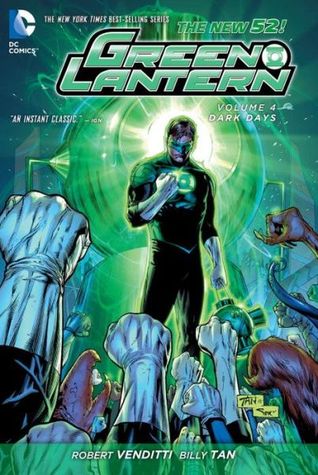
I cannot say that I have ever been a big Green Lantern fan. Sure, Hal Jordan has had his moments, and all the other GLs from Earth have been interesting from time to time, but the Lantern Corps as a whole has never been more than an endless alien cantina scene to me. However, since I’ve been touring the New 52 universe and had heard good things about this new GL, I decided to give this book a try. After finishing it however, all I can say is “Meh.”

The story itself starts with our testosterone infused and seemingly oblivious Hal Jordan somehow becoming the head of the Green Lantern Corps. Of course, Hal always thinks through the repercussions of monumental decisions (Yeah, right!), which is why he immediately ignores all his fellow GL’s protests and releases hundreds of Green Lantern rings out into the cosmos to find loads of new Lantern recruits when he has no apparatus in place to actual train any of them.

Naturally at the same time the snot nosed kids are coming in for training, all hell breaks loose on Oa. The Orange Lantern Larfreeze attacks while constantly repeating his desire to get some epic loot, and a powerful prisoner (Prixiam Nol-Anj) uses the confusion to attempt an escape. And of course, all these untrained new recruits stand around getting themselves killed because their new rings have delivered them into a war zone and none of them know how to actually use their power! But things only get worse for Hal from there.

Soon after getting things under control on Oa, our fearless GL leader discovers that Carol has given up on him ever growing up and actually acting as if he is in a relationship, and so she is calling it quits. (Okay, did it take her this long to figure Hal out? I mean, when has this New 52 Hal not acted with the maturity level of an eighteen year old frat boy.) And once Hal throws himself into his work, he discovers that an unexplained lose of power to Lantern rings is wrecking havoc to the Corps and, even worse, its cause is absolutely unknown.

At this junction of our tale, the only interesting character in this whole mess shows up. From the depths of time and out of space itself comes a giant scientist from a long dead universe, determined to save everyone from destruction at the hands of the Lanterns!

Relic, as the gigantic brainiac is called, has a wonderful mixture of evil righteous, where he basically is determined to kill everyone but only for the very best of reasons – reasons that even his victims can’t really disagree with. However, the only problem with Relic’s justification for extinguishing all Lantern users in the universe is that it is so persuasive that I wonder how any writer is going to fix this issue with the Lantern’s continued existence, because Venditti has now made all Lanterns the “bad guys.”

The story of Relic has many interesting twists and turns, but like many of these New 52 books, I discovered that it had huge “gaps” or “leaps” in the narrative. Too many times, I would be happily following along with the story of the Lanterns fight against Relic and then I would flip to the next chapter and Bam! a whole world would have been destroyed or a main character has died, but I never saw how any of it happened. While I have since learned that these “gaps” were due to Dark Days being part of a DC Green Lantern crossover story and these other comic issues not being included in this collection, it does not excuse DC’s decision to give a reader a story that is so obviously missing key sections of its narrative.

The only thing in this graphic novel that I have absolutely no complaints with is the art. Billy Tan (Illustrator) does a phenomenal job of capturing the epic nature of the Green Lantern Corps. Every alien is unique and beautifully rendered, while the action explodes off the page. So no blame for any shortcomings of this graphic novel can be laid at the feet of the artists.

All in all, Green Lantern: Dark Days is a ho-hum book. The story of Hal’s leadership of the GL Corps is pretty weak until Relic shows up, and while the Relic storyline is interesting, it is spread over several comics, which are not included in this collection, so there are big “gaps” or “leaps” in the story that are really confusing and leave out important events. Also, this story makes an epic reveal about where the power for the Lanterns comes from, but in doing so, it turns every Lantern into a “bad guy” every time he/she uses a ring. So potential readers, consider yourself forewarned.

The publisher provided this book to me for free in return for an honest review. The review above was not paid for or influenced in any way by any person, entity or organization, but is my own personal opinions.

Purchase the graphic novel at Amazon.

Posted in Graphic Novels | Tagged , , , , , , , , , , | 1 Comment

HEARTWOOD by FREYA ROBERTSON

17737061
My rating is 2 out of 5 stars.

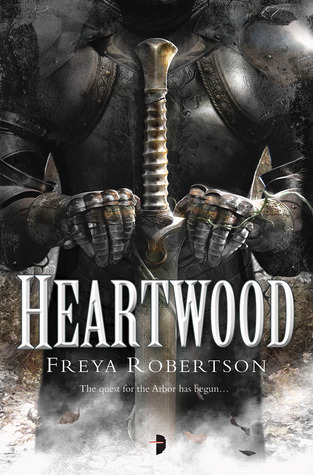
Heartwood by Freya Robertson is the first book in the epic fantasy series Elemental Wars. The story is filled to overflowing with massive world building, loads of characters, diverse races/species and many different viewpoints. To say it is “epic” is almost an understatement of just how “massive” this world is, and while I usually adore these types of books, this one did not catch my attention. Stick around, and I will try to explain why.

The story itself begins with representatives from all over the land coming together for a summit at the fortress temple of the Heartwood, where they hope to find a solution to the ills spreading across the world. For the land is slowly dying. None can deny it anymore. Food and game has become scarce. The weather has begun to change for the worse. And as the world becomes harsher, the hearts of its people grow cold; their every disagreement turning into violent bickering and strife. The only way to stop the rising tide of destruction is for some way to be found to heal the “Arbor.”

The Arbor itself is an ancient oak tree; a tree best characterized as the linchpin of the entire world. Its gentle magic nourishing and upholding all that is good and right, making the land itself a place inhabitable by the people. Yet now, some unknown ailment has afflicted the Arbor, and it is shrinking – dying most likely. If a cure for it cannot be found, the wise know that the lands will fall into chaos and death. Life itself may very well perish! And so the holy knights of all the lands come together for a great summit to avert disaster.

Good setup for an epic fantasy, don’t you thing?

I did too. Unfortunately, things start to go somewhat down hill after this.

The chapters regarding this great council read much like E television’s red carpet coverage of the Oscars. We get to meet each participant as they walk down the carpet and get their own five minutes in the spotlight. In fact, Ms. Robertson inundates a reader with information about these different people. Much of it useless – at least in this book. We get a history lesson on what land they hail from, a description of their land’s own unique religious beliefs, and a brief synopsis of why this guy/gal is important to what is about to happen. Then they walk on into Heartwood, and we do it all over again with the next person in line. Honestly, after a few pages, it gets tedious at best.

Once the pre-show coverage is over, the council turns out to be a big letdown — much like the Oscars. It quickly turns into a bickering session that even more quickly morphs into an excuse for everyone who hates each other to get into a fight. However, before our heroes can bloody their swords upon each other, the mysterious villains in the story attack, emerging from the river to cast themselves upon the hero filled fortress of the Arbor. A decision that seems foolhardy at best, since Heartwood has the lands mightiest heroes protecting it right at this very moment.

Correct me if I’m wrong here, but wouldn’t an enemy attack a target when it is least defended by the most incompetent people?

Anyway, after the watery enemies are cast back and the battle won, the survivors discover that something awful has happened while they fought: the leaves have begun falling off the Arbor!

When the holy knights pull their thumbs out of their mouths and unwind themselves from a fetal position, they discover that the “heart” of the Arbor is missing. Immediately, horrendous “rains” begin to fall over the lands, and now the wise prophesize (drum roll please) that all hell is about to let loose.

But do not fear! There is a way everyone can save the lands posterior from this cataclysmic disaster.

Epic quest alert! Epic quest alert!

Seven of them to be exact. Seven magical nodes that must be reactivated by seven, unique quest parties. Each group having to do different things to reactivate their own particular node. And if these seven quests can be complete then the wise believe the Arbor shall be healed!

At this point, I really wanted to close the book on Heartwood, because it was using far too many fantasy cliches to interest me, but I didn’t. I kept going, and to be fair, the remainder of the story is an okay read. The characters are fairly interesting, not standard fantasy types but more realistic with many interesting female knights among the groups. There are multiple character viewpoints and ample world building, because you have seven different groups galloping across the lands. The magic of the world, including the Arbor and the elements, is well developed and intriguing. And the final battle at the end was a satisfying conclusion to a first book in a series.

With all that being said however, I did have some things that detracted from my enjoyment of this novel. I’m sure you are sitting on the edge of your seat to read them.

1) I had trouble keeping all the characters straight in my mind, because the story line skipped from quest group to quest group, and I found myself forgetting what one group was doing by the time the story got back around to them. Perhaps I should have kept notes as I read, but unfortunately, I wasn’t forewarned that I needed to do that.

2) The story was just slow. Plodding almost. Part of this was due to the extensive time Ms. Robertson spent world building, but a lot of the blame also goes to the seven quest groups, which meant lots of repetitive talk of each group riding hard, finding an inn, sleeping, et cetera.

3) Too much dying, torturing, raping and general violence. Yeah, I said that. I know it sounds absolutely ridiculous for me to complain about that in an epic fantasy, but honestly, there is a point at which I just don’t care emotionally when someone else gets tortured, violated or killed. It becomes something like “Oh, John got killed. That is sad. Who was John again? Was he the one I didn’t like? Or was that James? Oh well, at least, I have one less character to keep up with now. And Percephalie, didn’t she get tortured earlier in the book? No. Damn, that must have been Andromache.” That might sound harsh, but unfortunately, after half the cast gets tortured or dies, I just don’t care anymore.

Those that know me or read my reviews understand by now that I tend to write more “negative” reviews on books I find disappointing. The simple truth is those novels which I am “disappointed” in are those that I was very excited to read and desperately wanted to love. Heartwood is one of those novels. It sounded like just my kind of series, but for some reason, it and I did not connect. Be that as it may, I’d still encourage other fantasy lovers to give it a try, because it might be exactly what you are looking for.

Netgalley provided this book to me for free in return for an honest review. The review above was not paid for or influenced in any way by any person, entity or organization, but is my own personal opinions.

Purchase the novel at Amazon.
Posted in Epic, Fantasy, High | Tagged , , , , , , , | 6 Comments

NOAH: EXISTENTIAL NIHILIST — WHO KNEW?

18805549
My rating is 2 out of 5 stars.

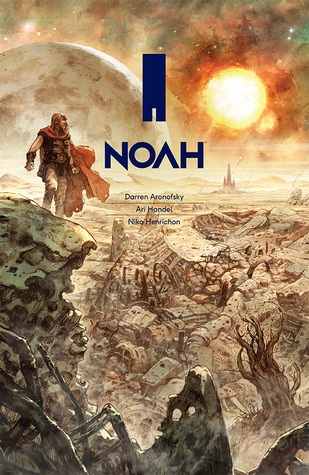
I honestly believe one of the most courageous and difficult things for an artist to do is to “re-invent” a famous story. When it works, an artist is given a triumph and a wreath of Delphic laurel is placed upon his/her brow by the adoring mob. When the artist royally screws up, the mob will throw garbage and curse his/her name. Perhaps that sounds unfair, yet it is still very much true and just comes with the territory of deciding to tinker with a fan/believers beloved story, and no doubt, Darren Aronofsky (story) and Niko Henrichon (illustrations) knew that when they decided to retell the Biblical Noah story. (And yes, this graphic novel is based upon the major motion picture Noah. I did know that.)

Now, I’m sure, most people are familiar with the basics of the Noah tale, but if not, it goes something like this. God creates the universe, the earth, all living creatures, and finally the first man and woman. This father and mother of mankind live in paradise until they sin against their creator. At that time, they are removed from the Garden of Eden and put out into a world now tainted by sin – mankind’s inherent evilness, if you will. Adam and Eve make the best of it though, have some children, and try to live their life. Unfortunately, one of their sons, Cain, kills his brother, Abel, and the avalanche of evilness just keeps picking up steam, as mankind invents more and more ways to ruin the previously “perfect” Earth and commit “sins” against the creator. A fact which soon leads “God” to “grow weary” of mankind’s continued evilness and determine to wipe out all living creatures (air breathers) by a worldwide flood before man’s evilness destroys the Earth. The only “righteous” man spared this watery fate is Noah and his family (wife, 3 sons and their wives) who basically build a huge ark, fill it with two of each kind of animal, and ride out a year long flood of the whole Earth. After the waters subside, the creator promises not to flood the earth again, places the rainbow in the sky as a sign of this promise, and then tells Noah’s family to multiply and repopulate the earth.

Those are the basic facts – as I understand them. (No, I am not a professional theology expert, so please do not lynch me if I have gotten something somewhat incorrect. Thanks for you patience with my human imperfections.) However, there are many facets of the Noah story that are not “fleshed” out in the ancient Judeo-Christian tale. Like what was the pre-flood world like? How were the people so “wicked” back then? What was Noah really like? How did he and his family build such a gigantic ark? How did Noah gather up all those animals and put them on a boat together? What did knowing all of mankind would die except for his family do to Noah’s psyche? What happened when people finally discovered that Noah was right and that only he had a boat big enough to save people from the prophesized cataclysm? And how did Noah’s family survive once the flood was over?

As you can see, Noah’s tale lends itself to becoming a marvelous apocalyptic story/film. It has all the bare bones needed to build an edge of your seat adventure tale for the ages with just a bit of re-imagining and filling in of details, and honestly, Aronofsky and Henrichon start this graphic novel doing just that, penciling in the blank spots of Noah’s story and gifting a reader with awe inspiring images of a legendary world. Noah is exciting. It is action filled. It has emotional impact. It is almost spiritual in many of its pages. Indeed, at the start of this graphic novel, the creative team does a marvelous job of tip toeing down that invisible line of “re-imagining” a story and adding excitement without changing it so much that its “fans/believers” become upset. But –

I mean, you knew there was a “but” coming, right? Honestly, there has to be doesn’t there? This is a book review after all, and any “review” is going to point out good and bad things about the book. Maybe not every reviewer does that, but fortunately for you (Because you obviously are one of those inquisitive people, who would always take the red pill, stay in Wonderland and ask Morpheus how deep the rabbit-hole goes.) I am accustom to pointing out unpleasant things while also dodging rotten eggs from my critics.

So as I was saying, Aronofsky does a marvelous job of providing an exciting, Noah story until he decides to begin providing a “message” to his readers. (Something which is never a good idea in an action story/movie, but which is especially not prudent when retelling a religious story to begin with.) However, Aronofsky is determined to turn this apocalyptic tale of worldwide destruction into a modern morality play, and so he soon casts aside the edge of your seat action regarding the end of the world for “greenpeace” proselytizing. The worst of it no doubt being the de-evolution of Noah, the would-be savior of mankind, into an existential nihilist, whose sole purpose is to ensure the destruction of mankind so that the cancer known as man cannot multiply to harm mother earth anymore.

Did you actually read that last sentence?

Uh-huh, sure you did. Let us take a moment to revisit it just to make sure you understood what I was saying.

Noah, the hero of our story, begins this tale as a fighter for right and is chosen by his creator to warn mankind of the coming apocalypse, build an ark to save his family and the animals, and while doing all this he turns into an existential nihilist. Existential nihilism being the belief that human life has no intrinsic meaning or value and that the entire human species is insignificant, without purpose and unlikely to correct its “sinful” ways if it is allowed to continue to survive.

“What?” Some of your are asking yourself. “Are you serious? An action story about the end of the world is preaching that man should be destroyed to preserve the environment. No way.”

Way, dude. Sorry to say I only wish I was joking, because Noah had real potential: a lost civilization, prophesized end of the world, single man against overwhelming odds, cute animals, epic destruction by a flood, and survivors having to rebuild civilization. Can’t get much better elements for a successful story, but Aronofsky decided to throw all those great plot points to the side and try to sell “greenpeace” existential nihilism in an action story/movie. Just a bad idea. Mainly because most people do not want a theology lesson in their action adventure story. You know, they just want — action and adventure.

In summation, Noah is a graphic novel that starts off great, has great artwork but falls flat as it changes from a pure action-adventure tale into a morality play. Read it at the risk of deciding that your continued existence has no meaning since you are the cause of global warming by refusing to stop eating meat, driving your car and using electricity.

Netgalley provided this book to me for free in return for an honest review. The review above was not paid for or influenced in any way by any person, entity or organization, but is my own personal opinions.

Purchase the graphic novel at Amazon.

Want to learn more about Noah and the Great Flood?

BE SURE TO CHECK OUT MY REVIEW OF
NOAH: THE REAL STORY

Posted in Graphic Novels | Tagged , , , , | 4 Comments

THE NEW 52 BATGIRL VOLUME 4: WANTED

18404437
My rating is 4 out of 5 stars.

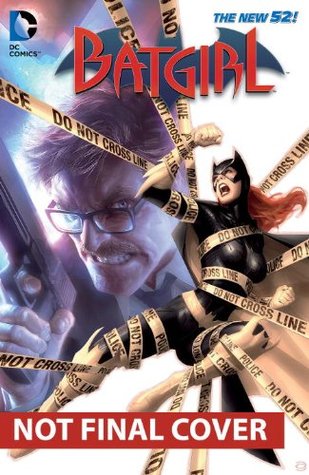
I’ve been sampling a lot of The New 52 lately, and my taste tour has finally gotten to the Batgirl cuisine, as prepared by Gail Simone (Story) and Fernando Pasarín and Daniel Sampere (Illustrations). While I was a longtime reader of the Birds of Prey comic, I can’t say I have ever been a Batgirl aficionado, and so as I began this comic collection, I had no preconceived notions of what Batgirl had to be like in this New 52 manifestation. However, after finishing Wanted, I must say that now all future Batgirl comics will be judged against this Simone/Pasarín/Sampere version, because this is “THE” perfect Batgirl in my opinion.

The collection itself contains issues #19-25 of Batgirl along with Ventriloquist #1. Here our caped heroine is struggling emotionally with the death of her brother, James, Jr., and her future career as a crime fighter is definitely up in the air. Not only that but there are issues with her continued relationships with Batman and the whole Bat family as well as real strain between herself and her father. But all is not gloomy in Barbara’s life as a new love interest appears – though even that has unforeseen complication.

Before Batgirl can come to grips with the good and the bad in her life however, our heroine is confronted by an especially nasty piece of villainy called The Ventrilogist, and her appearance gives this comic collection a major dose of creepy psychosis. I mean, there is nothing going to test your mettle as a crime fighter liking going toe to toe with a mentally deranged chic and her demented dummy; both of whom seem more than willing to kill anyone (ordinary citizens or fabulous stars) just for kicks. And if that isn’t difficult enough, Batgirl finds herself trying to do this while side stepping her own father’s quest to hunt down and bring to justice the worst criminal in all of Gotham: Batgirl herself!

From out of this hodgepodge of ongoing plots, Gail Simone does her usual outstanding job of creating a multi-faceted character. For you see, this New 52 Batgirl is not a super heroine caricature but a very real and plausible person, who just happens to live this extraordinarily dangerous life as a crime fighter. That is why the sections of Simone’s story focusing on Barbara Gordon happily going shopping with a friend or enjoying a night out dancing with a guy does not read like filler material but are essential parts of the whole Batgirl story. And this dual role of Barbara as super heroine and average girl is one of the main reasons Simone absolutely nails the New 52 Batgirl and makes it such an enjoyable collection to read.

The other reason to sample Wanted is the amazing artwork, which is quite frankly an ideal match for Simone’s story. For Fernando Pasarín and Daniel Sampere do an outstanding job of capturing the creepiness of Batgirl’s super hero world while also illustrating the normalcy of Barbara’s daily life. Both parts of the tale meshing so well and rendered so beautifully that it adds even more enjoyment to the overall story and makes it difficult to imagine anyone else ever drawing this comic.

Some stories just click with a reader. The New 52 Batgirl Volume 4: Wanted is one of those books with me. It gave me everything I am looking for in a great comic: beautiful art, multi-dimensional characters, and an engaging story. I’d highly encourage everyone to give it a try and see if it is too your liking as well.

I received this ARC from the publisher in exchange for a fair and honest review. I’d like to thank the publisher for allowing me to receive this review copy and inform everyone that the review you have read is my opinion alone.

Purchase this graphic novel at Amazon.

Posted in Graphic Novels | Tagged , , , , , , , | 2 Comments

THE NEW 52 AQUAMAN VOLUME 4: DEATH OF A KING

18373334
Aquaman: Death of a King by                    Geoff Johns.

Genre: Superhero Comics

Series: New 52 Aquaman, Vol. 4

Publisher: DC Comics (May 20, 2014)

Author Information: Website | Twitter

Length: 192 pages

My Rating: 3.5 out of 5 stars.

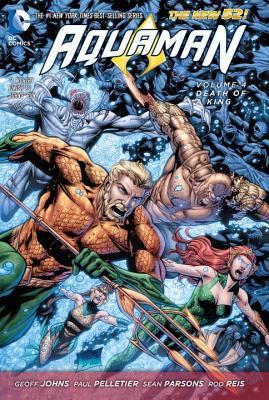
The New 52 Aquaman 4: Death of a King collects issues #18-25 of the ongoing series. Geoff Johns creates the story, and Paul Pelletier brings it to life with his artwork. And while the two do an excellent job of coaxing this tale to life, it is still missing some ingredient to actual make it a real page turner.

The adventure itself begins with a bang as Arthur Curry (aka Aquaman) is the unsettled King of Atlantis after the events in the previous story arcs. He is determined to clean up the mess made by Atlantis’ attack on the surface world and has sent his forces around the globe to recovery Atlantean weapons and artifacts taken by the Scavenger. However, even while Arthur is attempting to live up to his responsibility to protect the seas and its denizens, many of his new subjects do not view it as such but rather as a sign of his weakness and desire to side with the surface dwellers rather than his own watery subjects. Not only that but there are even rumblings that Arthur is the right man to be king, and that Atlantis’ previous ruler should return from his imprisonment in America and take back his rightful place upon the throne. Add to this sad state of affairs the fact that Mera herself is reluctance to return with him to the ocean, and one can understand Arthur’s fragile mental state as the book begins.

Naturally, Aquaman gets no chance to come to grips with his problems, however, because immediately a new threat emerges. An ancient denizen of the watery depths is inadvertently reawakened by Arthur himself, and his resurrection from the shadowy past spells trouble for our aquatic hero. For this enemy has power unprecedented, and he is determined to unseat this false Atlantean king. In order to fend this threat off, Arthur finds that he must uncover a horrific truth about Atlantis’ past and his own forefathers while dealing with potential traitors from within.

From this setup, Geoff Johns does his best to throw every curve ball in his repertoire at a reader. There are fights galore, personal musings, relationship issues, ancient knowledge, and unexpected twists. We even have side stories involving other characters. Each of these individual dramas drawn in stunning style by Paul Pelletier and the art team. Indeed, for most of the graphic novel, the art is spectacular, expertly capturing the aquatic underworld of Aquaman and hiding any stumbles in the tale itself. But at the end of the day, pretty pictures only go so far to make a story interesting

And there lies the problem with this collection. It starts off very strong and ends strong, but – in my opinion – much of the in-between of Death of a King is rather ho-hum reading. Sure, it is somewhat interesting and adds some layers to the Atlantean and Aquaman mythos, but it never gripped me and made me want to turn the pages as quickly as possible. While I realize that every story arch is not going to be an epic masterpiece, this one left me rather “meh” at best.

In summation, Aquaman Volume 4: Death of a King is an “okay” read, more than worthy to waste a few hours, but after finishing this one, I do not believe it will end up on your “favorite” list. Even with that being said, I still enjoyed the updated version of Arthur Curry/Aquaman and will look forward to reading more about him in the future.

I received this ARC from the publisher in exchange for a fair and honest review. I’d like to thank the publisher for allowing me to receive this review copy and inform everyone that the review you have read is my opinion alone.

Purchase the book at Amazon.

Posted in Graphic Novels | Tagged , , , , , , , , | 1 Comment

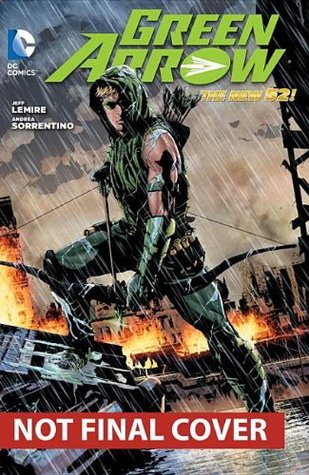
THE NEW 52 GREEN ARROW: THE KILL MACHINE

18373331
My rating is 4 out of 5 stars.

Green Arrow, Vol. 4: The Kill Machine was my first sampling of this New 52 Green Arrow, and honestly, I was a bit hesitant to try it, because I’ve always been a fan of Oliver Queen (especially Kevin Smith’s amazing take on Green Arrow years ago) and was worried I might not appreciate this re-imagined/re-booted version. However, after reading this collection in one sitting, all I can say is wow! Jeff Lemire (story) and Andrea Sorrentino (illustrations) have absolutely nailed it and made this – by far – my favorite New 52 character.

There are lots of things to like about the story that Lemire gifts a reader with in this collection. We have Oliver Queen exhibiting the determination, pride, and loud mouth tendencies that have always been his trademarks. There is a whole, new mythos added to Green Arrow’s history and even a new back story; both of which make the whole Green Arrow story so much more “epic” than it has ever been in the past. We have old, familiar villains that are now updated with stellar back stories and believable super powers. There are also new, mysterious characters who instantly become favorites. Through it all, Lemire uses each new revelation or idea to drive forward his mesmerizing plot; subtly crafting an action/adventure story that reads more like an award winning crime novel than a superhero comic.

Any praise of Green Arrow: The Kill Machine would not be complete without highlighting the absolutely original artwork of Andrea Sorrentino. It is no secret that an action-packed story has to have the correct artwork to compliment it, or it just becomes another ho-hum affair, and Lemire’s story (as compelling as it was) would have fallen flat if not for Sorrentino’s brilliance. In this collection, Sorrentino’s mastery of his craft is on full display, as he puts on an art clinic of how to do action right with just enough originality to set it apart from the crowd yet still be assessable to the most casual reader. When Arrow is fighting, the art shows a fluidity of action. When he is in emotional turmoil, the anguish is clearly seen in his face and in his posture. When Oliver is in excruciating pain, his howls and grimaces radiate off the page. Quite simply, as good as the story was here, the artwork was even better. It was simply amazing.

Now, some of you might be concerned about picking up volume four of a comic series. No doubt, you imagine that there are all these interwoven plots that have been going on for years and that you must have all that back story memorized so as to enjoy a fourth act of Green Arrow’s tale. While I can understand your concern, I am here to tell you it is baseless, because if you’ve never read Green Arrow before – either the old version or the New 52 version – it is not a problem. This collection reads very much like a standalone novel. Sure, you know things have happened in the past, but all the back story you need to appreciate The Kill Machine is quickly and succinctly provided by Lemire without it ever interrupting the flow of the overall tale.

In summation, if you appreciate silky smooth action stories, you need to give Green Arrow: The Kill Machine a try. This one will draw you in so quickly and so completely that soon you will find yourself trailing along behind Lemire and Sorrentino like a kid chasing the ice cream truck, desperate to taste the new flavors that this new Green Arrow has in store for you. It exceeded my expectations, and I can honestly say it turned me into a fan of this New 52 Green Arrow, and he and I will definitely be visiting each other again soon.

I received this ARC from the publisher in exchange for a fair and honest review. I’d like to thank the publisher for allowing me to receive this review copy and inform everyone that the review you have read is my opinion alone.

Purchase the graphic novel at Amazon.

Posted in Graphic Novels | Tagged , , , , , , , | 3 Comments