THRONE OF THE CRESCENT MOON by SALADIN AHMED

11487807
My rating is 2 out of 5 stars.

“Dhamsawatt, King of Cities, Jewel of Abassen
A thousand thousand men pass through and pass in
Packed patchwork of avenues, alleys, and walks
Such bookshops and brothels, such schools and stalls
I’ve wed all your streets, made your night air my wife
For he who tires of Dhamsawaat tires of life”

This is the home of the protagonist of our story: Doctor Adoulla Makhslood, and he is the last “real” ghul hunter in the city, though there are always charlatans about who prey on the ignorant. However, Adoulla is getting old; his desire to continually risk his life destroying heart eating ghuls and other magical monsters waning as his years lengthen. Indeed, he finds that now his heart’s desire lies in the comfort of his beloved city, his simple house, the familiarity of his books, the soothing taste of his favorite tea, and a desire to settle down with the love of his life – a woman who adores him but despises his ghul hunting ways.

No matter his desires, there is horrible trouble brewing. Adoulla feels it within his soul. A terrible evil is stalking his beloved Dhamsawatt. That is why he continues to have the nightmares. Dreams where he finds himself walking through “streets, waist high in a river of blood . . . Everything tinted red – the color of the Traitorous Angel . . . And all about him the people of Dhamsawatt dead and disemboweled.”

With such horrid visions haunting his sleep, how can Adoulla do anything but continue his ghul hunting. Who would replace him?

Not his young assistant Raseed bas Raseed. No, that young holy man and warrior might be a devote follower of the Almighty God and an expert swordsman, but he lacks both the desire and the training to replace Adoulla. Though the doctor can admit, at least to himself, that the boy is helpful beyond measure and has even saved his life more than a few times.

The only others who have ever shared Adoulla’s path in life are his neighbors and fast friends, Dawoud, a weaver of spells, and his wife, Litaz, expert of the art of alkhemy. They have aided him time and time again, shared his hardships and triumphs over horrendous foes, and suffered personal losses greater than he could ever understand. Yet they have their own life, and Litaz tires of Dhamsawatt, wishing to return to their homeland far to the west and south.

Alas, if anyone must face this horrid ghul apocalypse, it has fallen to Adoulla – though he feels too old and must call upon his friends to aid him.

This is how Throne of the Crescent Moon begins. Great setup for a story! (And did I mention how awesome that cover was?) Well, between that cover and this beginning, I really thought this would be an interesting read. But as I kept flipping the pages, I kept missing something. Something I assumed was my fault for not seeing, but as I tried harder to locate it, it became painfully obvious the author had not included it in this novel.

What was missing you ask?

A sense of urgency.

To me a story is a multi-faceted thing. It needs an interesting plot (several of them is better), well-rounded characters, good magic system (in a fantasy book), and a sense of urgency to make me care what is going on. One is just as important as the other, but there MUST be urgency. This urgency can be numerous things: war, political intrigue, environment disaster, zombie apocalypse, et cetera. It doesn’t really matter as long as a reader I feel like I’m caught up in a wave of events that is propelling me forward through the pages, making me desire to keep reading to see how it all ends. If I do not feel any urgency, chances are I’m not really “into” the book.

As I read along with Throne of the Crescent Moon, I was never swept up in events. How could I be when the characters themselves were so apathetic about the whole ghul apocalypse. Honestly, our protagonist, Adoulla, is having these horrid nightmares, but he spends paragraph after paragraph filled with concerns about getting too old for all this, his love of tea, his comfortable home, and his desire to reignite a relationship with his lady love. All these things seemed more important to him than actually stopping this massive threat of genocide.

If the ghul apocalypse is so horrible, why isn’t our hero frantically trying to find the way to stop it instead of drinking tea?

Who knows. But Adoulla isn’t. Nor his assistant Raseed. Nor Dawoud. Nor Litaz. Not even Zamia, whose whole tribe has been killed by this monster. Nope, they methodically go about their personal lives. They take time to have tea, celebrate a feast, visit old lovers to reignite past relationships, are love sick over one another, and generally act as if there is no sense of urgency to anything. I mean, it is just a ghul apocalypse. Guess they deal with this sort of thing all the time. No need to get help. Naw, they got this. Just go home and drink some more tea, good citizens.

This lack of urgency was even present in the fight scenes – the few there were. Let me give an example. At one point, Litaz and Zamia get in an altercation with some religious fanatics, and they begin to argue, setting up the fight to come. Here is an excerpt from this big “altercation.”

“Suri,” Litaz repeated. “A beautiful name. And very, very old.” She turned to the Students with a clearly forced smile. “Surely you brothers see the sign from Almighty God here? The Heavenly Chapters’ story of Suri says “O Headsman, drop your sword and serve His mercy! O Flogger, drop your whip and serve His mercy!’”

The gray-haired Student spread a conciliatory hand, but he sneered as he did so. “The Chapters also say ‘And yea, proper punishment is the sweetest mercy,’ do they not? A new era is coming, outlander? An era when only those who walk the path prescribed will prosper.”

You can feel the adrenaline pumping in this altercation, can’t you?

In that excerpt, you probably also noticed that there was a good bit of scripture quoting. This is the norm, not the exception in this novel. In fact, the characters are quoting holy scriptures all the time, no matter what the situation. Now, I agree this quoting of holy scripture was part of the characters’ cultures, but it became too repetitive, reading as filler material after a while. Can’t explain my dislike other than to say it was just distracting.

I did finish this book, but I did so more out of a need for completion than any desire to see how the “story” ended. The focus of the novel seemed to be the people and the city, so eventually, I tried to just get to know them instead of looking for a grand storyline. After I did that, the reading became easier, because Adoulla, Baseer, Zamia, Damoud, and Latiz became real people to me. I knew about their likes and dislikes, their dreams and regrets, and even their personal habits – Adoulla liked tea very much. And by the end, I felt as if I had lived a few days with them in glorious Dhamsawaat, which was okay. I suppose I focused on the journey and not the destination.

Now, this Saladin Ahmed’s novel will not go on my favorite list, but I do not regret reading it. It was a close call with me if this was a 2 star or 3 star book, but since I can’t see myself ever rereading it, I went for 2. I personally like more epic stories with lots of action or suspense, and if you feel the same, I doubt you will find this book enjoyable. However, if you can read it just for the characters, it might be right up your alley.

Buy Throne of the Crescent Moon (Crescent Moon Kingdoms Book 1) at Amazon.
Posted in Fantasy | Tagged , , , , , , , | 2 Comments

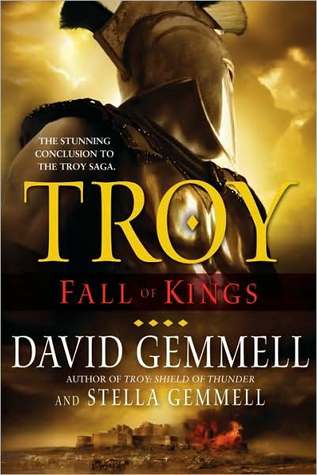
FALL OF KINGS by DAVID GEMMELL

870807

Fall of Kings by David Gemmell

Genre: Historical Fiction

Series: Troy #3

Publisher: Ballantine Books (August 27, 2007)

Length: 496 pages

My Rating: 4 out of 5 stars.

Troy: Fall of Kings is the end of David Gemmell’s epic historical series, and here a reader will find portrayed the final days of the Trojan War, the duel between Hektor and Achilles, the Trojan Horse, and the fall of mighty Troy. Without a doubt, the novel dazzles in its realistic portrayal of these historical events, leaving one both in awe of its brilliance and perplexed by its obvious flaws.

The good parts of the novel are easy to point out. David Gemmell and his wife (Who I understand finished said book after her husband’s death.) did an outstanding job of portraying realistic characters, who fit perfectly into the historical narrative of this period. These characters behave realistic based upon their established personality, and some of them almost burst off the page in their brilliance. The same can be said about the combat scenes in Fall of Kings, because they radiate ultra realism as the Greek and Trojan warriors exude fear and adrenaline while clashing in ancient combat. Even the final duel between Hector and Achilles is superbly done, penned in such detailed and dramatic fashion that it must stand as one of the best portrayed combats between heroic warriors in all of literature. And we must not forget the final “Trojan Horse” resolution, which might be the most well thought out and simplest solutions I’ve ever encountered.

No matter how well the Gemmell’s did some things, however, there are still obvious flaws with the story. Helikaon and Andromache, in particular, make certain decision that do not ring true to their characterization throughout the series and seem forced so that other important moments in history can be written about. Another is the resolution – if you can even call it that – of Gershom’s strange plot line that was somewhat mystifying throughout the series. There are other examples of characters just disappearing or behaving strangely throughout the later part of the book, especially the last few chapters where Troy’s survivors are shown fleeing for their lives, but I do not want to belabor the point, only point out that these moments detract from the effect of the narrative as a whole.

With all that being said, I enjoyed the novel. It was a fitting ending to a good series. A trilogy where the Gemmells did an excellent job of taking the myths about Troy and turning them into compelling historical fiction. Not to say they did not take artistic liberties with historical fact, but that, even though they did, it rang more or less true. For attempting to shed a light of reason on the Trojan War, this novel and series is a must read for lovers of historical fiction.

Finally, I would be remise if I did not salute the legendary David Gemmell. There will never be another writer who can do justice to a warrior’s true spirit as he did in this series and all his novels. A final triumph for a true master of his craft!

Buy the book at Amazon.

Posted in 4 Stars, Historical Fiction | Tagged , , , , , , , , | 2 Comments

ASCENDANCY (THE GODSWAR SAGA #1) by JENNIFER VALE

ASCENDANCY My rating 3 out of 5 stars.

This is one of those books that I picked up just because it looked interesting. And somehow I got lucky, because Ascendancy was a first class epic fantasy of war and magic.

The story takes place upon the world of Obsidian where two millenniums ago a race of Immortals emerged from the nether. At first, they were helpers and bearers of knowledge to the peoples of the world, but soon they “changed,” ruling the world as living gods.

Eventually, the “gods” turned on one another. Some slight igniting the Godswar, where all the Immortals were destroyed and nearly all life obliterated on Obsidian. But as they faded from the world stage, these creatures left behind a wondrous gift: Aether.

Aether is a fine mist of energy surrounding and permeating the very air of Obsidian. While invisible to most, the Ascendants, their followers the Bound (trained magic users) and the Unbound (wild magic users) can see and channel it, using Aether to enhance their senses and perceptions, even to reshape the very energy and matter of the world.

With this wondrous gift, the races of Obsidian heal their lands, carve out continent wide kingdoms, and build civilization to heights never dreamed possible. But with all these Aether-users, the wise of the world fret that a new Godswar is inevitable. How can they stop it?

A system of Aether-user control is established. A way by which an “Ascendant” binds others to his/her power, making them a “Bound”; a symbiotic relationship where the Ascendant allows the Bound to use Aether and the Bound is monitored for unlawful or destructive use of his/her power. In this way, a single Ascendant maintains control over hundreds, perhaps thousands, of Aether-users.

Like all things, however, this system of control is imperfect, for there are people who can control Aether without need of an Ascendant. These Aether-users are called “Unbound” and are hunted down, forcible placed into “asylums” to guard them against destructive use of their power.

No matter the flaws of the system of control, the Ascendants have allowed life to flourish upon Obsidian. But now war is brewing. A conflict that might be as destructive as the Godswar itself.

In the Kingdom of Galvia it all begins. This small buffer state between the Crell Imperium and the Solarian Alliance is being overrun by the Crell. During the last stand, many important characters are introduced; people who will go on to play huge roles in the tale to be told. Acts of heroism occur. Selfless sacrifices are made. People die. Children have their personality warped by the brutality they witness. And as it ends, a new world has been formed; one where world war is only a breath away and even the most insignificant personal acts may be the spark to ignite it.

From this start, Jennifer Vale crafts a story from multiple view points, jumping from the heart of the Crell Imperium to the halls of the Solarian Alliance to the backrooms of Galvia. Characters from the prologue return in different roles. New heroes and villains are introduced. Well intentioned people begin to do horrible things in the name of good. Crimes against humanity are committed to maintain peace. An object of power is found and sought by all sides to the coming conflict. And slowly, ever so slowly the world continues its unstoppable slide toward a cataclysm that it is not – and cannot – be prepared for!

All in all, Ascendancy was an enjoyable read. The plot had enough twists and turns to keep me interested; Jennifer Vale switched from one plot line to the other with little difficulty, weaving them each into a splendid tapestry of action, intrigue, and world building; none of the main characters were one dimensional – though of course there are a few who lean that direction; and even the “bad” guys were relatable – no matter how disturbing their behavior might be. But what sold me on Ascendancy was the Aether-wielding paladins, who were the best sword and sorcery equivalent of Jedi Knights that I’ve ever run across. To say these guys were dazzling doesn’t do justice to their dynamic duels and Aether casting.

Like many indie fantasy works, however, this novel did have its fair share of problems: wordiness and a lack of refinement being the most pressing issues. But with a bit more editing, tightening up of the storylines, and SOME MORE PALADIN ACTION, I think all that could be easily solved – or overlooked by a reader. 🙂

Now, I won’t go so far as to say Ascendancy is the best indie fantasy I have read, but I will say that it had lots of great ideas, some strong characters, and enough interconnecting plot lines to make it a pleasure to read. Hell, it even left me wanting more, which doesn’t always happen. For those reasons, I would recommend any fantasy reader try this one – if you can find it within yourself to overlook the editing issues.

Buy Ascendancy (The Godswar Saga Book 1) at Amazon.

Posted in Fantasy | Tagged , , , , , , , , | 3 Comments

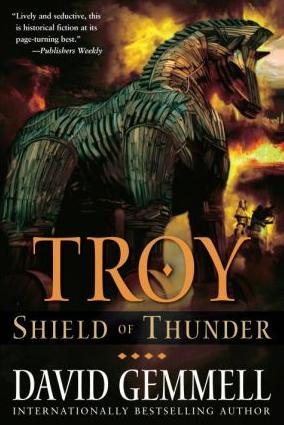
SHIELD OF THUNDER by DAVID GEMMELL

44012
Shield of Thunder by David Gemmell

Genre: Historical Fiction

Series: Troy #2

Publisher: Ballantine Books (March 27, 2007)

Length: 512 pages

My Rating: 2 out of 5 stars.

Book one of this series started off slow but really picked up speed as it reached its conclusion, so I started book two very excited to see where Gemmell was going with it. Unfortunately, Shield of Thunder really failed to deliver.

As soon as you begin this book, you will notice that Gemmell has skipped forward in time. No big deal really except for one important fact: a tragic event has occurred, which has left one of our main characters dead or dying. (I suppose the author might have done this to build suspense or tension, but it had the affect of annoying me more than anything else.) And so, with this former main character in limbo, the focus of Shield of Thunder shifts to a brand new character, Piria, and two, minor characters, Kalliades and Banokles, from book one.

Immediately, our new stars take center stage, uniting in tragic fashion before their backstory is revealed. Unfortunately, from this intriguing beginning, the story takes a big nosedive as the three journeying by sea to Troy (IF this sounds like deja vu after reading Book I I understand completely.), and even Odysseus’ presence or the hopeless love of one of the companions for the other can’t make this sea trip any better than the one in Lord of the Silver Bow. Honestly, if not for the constant interludes with Andromache in Troy itself, the book would have floundered from the start, but once again the city of Priam comes to the rescue, as the politically charged wedding games of Hektor and Andromache liven things up with political machinations, emotional fights, and the dramatic return of an old character.

By the end of the wedding games, Shield of Thunder was right back on pace, rushing forward not only toward the beginning of the Trojan War but also toward the emotionally charged completion of Piria, Banokles and Kalliades’ quest. But, alas, Gemmell once again crushed my hopes for this novel. Let me explain.

One, the epic quest of Piria had been the major plot line in the book from page one. Gemmell spends chapters explaining it, making it heart-rending, and setting up a climatic ending to it. Then, when Piria, Banokles and Kalliades are moments away from completing it, things just . . . fizzle out. I won’t explain how, but Piria’s story just ends. No other way to say it. Boom it is gone, and you sit there and ask yourself why Gemmell spent all this time building this up to just snuff it out like a candle flame. Big letdown.

Second, Gemmell skips forward in time again. The first time it was between book one and two, so I can live with that even though I didn’t like it. Here, however, there is no reason for the time skip. One minute, there is a looming war between Mycene and Troy, and the next it has been going on for years. We hear about all these huge battles that have taken place. Characters talk about Hektor’s victories and Odysseus’ strategic brilliance, but what we actually read about is Kalliades and Banokles’ struggles. And, while I did like both characters, Kalliades spends more time waxing philosophical on his inability to love anyone rather than actually fighting.

Third, Gemmell has this annoying habit of giving you a character, feeding you a backstory then never returning to him. The Egyptian, Gershom, is a prime example. Book one starts off with him getting lots of page time; we get a detailed backstory with some plot issues twisting around. Then in Shield of Thunder Gershom goes poof! and disappears. Oh, he makes some appearances, but nothing related to his backstory. And he isn’t the only character treated this way by the author. It is beyond irritating.

So while Shield of Thunder is an okay read, I can’t say I really liked it. Honestly, Gemmell barely keeps his Trojan War epic afloat with this one.

Buy the book at Amazon.

Posted in 2 Stars, Historical Fiction | Tagged , , , , , , , , , | Leave a comment

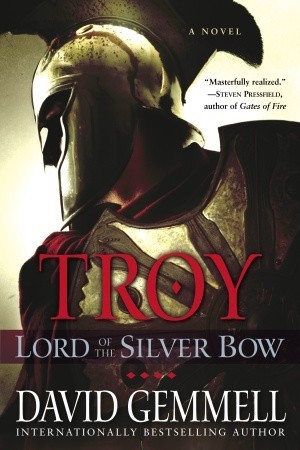
LORD OF THE SILVER BOW by DAVID GEMMELL

257149
Lord of the Silver Bow by David Gemmell

Genre: Historical Fiction

Series: Troy #1

Publisher: Ballantine Books (October 31, 2006)

Length: 483 pages

My Rating: 3 out of 5 stars.

My rating is 3 out of 5 stars.

Wow, a book about the Trojan War with a new protagonist and a different – perhaps more realistic – portrayal of the Greek world and the reasons for the great struggle. I couldn’t have ordered a book more suited to my tastes.

After finishing my read, all I can say is that Lord of the Silver Bow is okay. On one hand, it does a wonderful job of presenting the Greek world of the Aegean Sea in a more historic and realistic way with lots of re-imagined historic characters. However, on the other, the first half of the novel is plodding and suffers from the introduction of two, new characters.

So who are these new heroes of Gemmell’s Troy and what was wrong with them, you ask?

Well, the protagonist of the book is one Helikaon, a warrior-prince of Troy’s empire. He is all that a hero of ancient Greece should be: tall, strong, a great warrior, a great sailor, a wise trader, and a friend to Mycene, Trojans, and Cretans. Unfortunately, Helikaon is also aloof and rather boring. Oh, Gemmell tries to explain this behavior by providing him with a dramatic back story, but no matter how awful his upbringing and no matter how angst ridden he is, Helikaon starts out as a one dimensional character, who broods more than he excites.

The other main character of the novel is the beautiful and strong-willed Andromache, a priestess fated to marry an important Trojan hero. Unfortunately, that hero does not seem to be Helikaon. However, since any tale about Troy needs a tragic love story, Andromache becomes the obsession of the testosterone-filled males in Lord of the Silver Bow, and so instead of the classic Paris and Helen love story, we have a new one involving Andromache and Helikaon and her future husband. The only problem with this new love triangle is that Andromache starts out this story nearly as boring as Helikaon, and so she and her star-crossed lover’s passion for one another seems very unrealistic and not very compelling.

At about the halfway section of Lord of the Silver Bow, I found myself bored out of my mind by Helikaon, Andromache, their attraction, and the seemingly endless sea voyage to Troy, and I honestly began to wonder if I would be able to finish the story. Instead of writing a review, I envisioned throwing this book on my huge stack of “try it again later” novels. Then something most unexpected happened. This story came to life.

All of a sudden, Helikaon and Andromache’s ship reached Troy, and once at the golden city of legend, everything came into focus. The city of Priam providing just the right backdrop for this story to be transformed into something well worth reading.

That boring hero Helikaon? Once he stepped upon the streets of Troy, he sprang to life, becoming more dramatic and lordly. His innate heroic qualities reflected off both the kind and the devious members of the Trojan royalty. His unattainable desire for the betrothed Andromache becoming more compelling, as it is mingled with another love story between two unlikely but likeable minor characters.

And Andromache? Her introduction to the grandeur and decadence of Troy’s royal court transformed her into a determined woman, willing to suffer the wrath of a king to live by her own terms. Her desire for one man seemingly at peace with her love for another. And to see her deal with megalomaniac King Priam and his devious children was a real treat.

Add to this the tense situation in the Trojan hegemony, where armed conflict between Agamemnon’s Mycene and Priam’s Trojans is inevitable, and you can see that our two protagonists arrival at the legendary city was destined to not only reinvigorate Helikaon and Andromache but provide plenty of sword swinging action, which it does. For almost immediately, gritty combat ensues, as a reader is swept up in Gemmell’s classic testosterone splendor. The sounds of swords clashing against shields rings through one’s ears. Blood splatters across the pages. Courageous men fight against overwhelming odds. And at the end, the last words of love spoken between two star-crossed lovers brings a tear to your eye.

Yes, Lord of the Silver Bow is not a great book, but it is very good – especially the last half. So while it has its problems *cough* The first third of the book was boring *cough* it is still a good solid Gemmell read — if you can just hold out until you get to Troy.

Buy the book at Amazon.

Posted in 3 Stars, Historical Fiction | Tagged , , , , , , , | Leave a comment

THE GUNSLINGER (THE DARK TOWER #1) by STEPHEN KING

The Gunslinger My rating 4 out of 5 stars.

The Gunslinger is one of those books that evokes strong reactions in readers. You could simply say that people either love it or hate it but that is really too simplistic. Rather Stephen King evokes such a myriad range of different emotions with this science fiction/fantasy western that it is perfectly normal for an individual to feel both awed by its brilliance yet completely unhappy with its conclusion. I realize that is strange to say, but it is absolutely true.

What else is true is that no review will ever be able to tell a prospective readers whether they will adore or despise The Gunslinger – and The Dark Tower series that follows. Quite simply, the only way to know is to put on your cowboy boots and cowboy hat and accompany Roland Deschain out into the world that has “moved on.”

As a reader embarks upon the quest for the Dark Tower, he finds himself following along with Roland Deschain as “the gunslinger” crosses a strange post-apocalyptic “Old West” on the tail of his most hated enemy: “the man in black.” This villain was responsible for ensorcelling Roland’s mother, helping to kill Roland’s father, and had a hand in the destruction of everything that the gunslinger knew and loved in his world. So for years, our rugged, gun-toting hero has diligently pursued “the man in black”, determined to make him pay for what he has done, and now he is tantalizingly close to finally running his quarry to ground. Yet before the epic confrontation can happen, Roland finds himself confronting crazed citizens of a small town, meeting and loving a young boy, and ultimately dealing with the specters of his own haunted past.

After finishing this amazing story, I’m not ashamed to admit that I myself was one of those readers torn about my feelings for it. On one hand, I adored Roland and was desperate to learn more about his shadowy past, the why of his world’s strange condition (a place so familiar to our own yet obviously alien in that alternate time stream way), and what the Dark Tower actually was. However, on the other hand, when the tale was complete and the ending digested, all I felt was . . . a big so what!

Perhaps that sounds disrespectful of me. I know this is Mr. King’s masterpiece, but this novel — like the series that follows — is a flawed masterpiece. Filled with memorable characters and masterful stories yet missing the cohesiveness of other epic series like The Lord of the Rings. The sad truth is that The Gunslinger is a grand story that lacks a real ending, which, unfortunately, is a harbinger of things to come in The Dark Tower series as a whole.

With that being said, you probably wonder if I am discouraging people from setting off on this grand journey with Roland Deschain.

Absolutely not!

While The Gunslinger has its flaws (as does the series as a whole), there is no deny that it is an epic journey that whisks you away to another place with some of the most memorable characters in literature. And when you are done with it (Whether that be after one book or the whole series is entirely up to the individual.) it will be something you will always remember. Whether you recall it fondly or hatefully you will never know until you begin. So give this novel a try and decide for yourself if you’d like to follow the gunslinger all the way to the Dark Tower.

Buy The Gunslinger: (The Dark Tower #1)(Revised Edition) at Amazon.

Posted in Fantasy | Tagged , , , , , , , , | 6 Comments

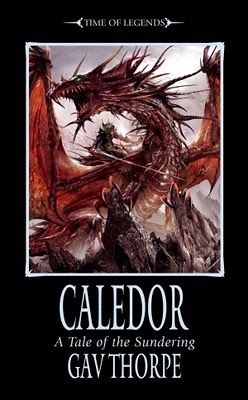
WARHAMMER TIME OF LEGENDS: CALEDOR by GAV THORPE

8604654
My rating 3 out of 5 stars.

The final book of the series. I have to say I was expecting a lot out of this one. I mean, this is the story where Thorpe gets to resurrect our villian Malekith, turn Prince Imrik into the mighty Caledor, fight a civil war, and then finish it off with the Sundering. Perhaps my expectations were too high, because after I read this one I was disappointed.

Now before anyone gets annoyed, I want to make clear that I still enjoyed this book. The action was just as gripping; the self-righteous evilness of Malekith both repulsive and compelling; and the appearance of all the heroes of both sides always tactfully written. But the ending – the most climatic moment of the whole series – just didn’t have that wow factor that I was hoping for. Honestly, as I read those last few chapters, my thought was more along the lines of “That is it?” rather than “THAT IS IT!” Something which disappointed me, because Thorpe’s trilogy turned me into a Warhammer fan, and I desperately wanted to love this book.

All criticism aside however, this is still a good book and deserves a place on all fantasy readers “to read” list.

Posted in Fantasy | Tagged , , , , , , , | 3 Comments

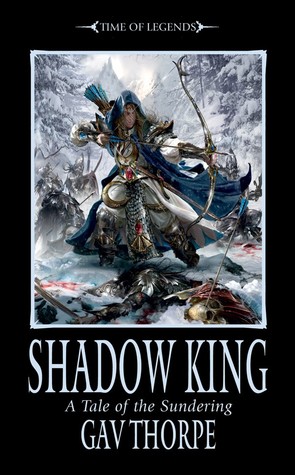
WARHAMMER TIME OF LEGENDS: SHADOW KING by GAV THORPE

6949411
My rating 4 out of 5 stars.

Great book! I have to commend the author for making what could have been a contrived story of loss and vengeance into a very compelling read. Alith Anar’s tale really came to life in the pages, making me see his heartfelt story on a more personal level even as it meshed with the over arching story of Malekith and the elven civil war (if that is the right way to categorize this war). By the time Alith’s story reached the point in time where Malekith ended, I could barely put the book down, wanting to see where our hero was heading as fate continued to slap him down again and again.

The only criticism I have of Shadow King is that certain events just did not seem very realistic. I won’t post spoilers, but certain things toward the end of the book seemed rushed as if the author had to tie up a loose end quickly or throw in a clever plot device to jerk our main character back into line for where he is suppose to go. These few scenes annoyed me even though I was too attached to Alith by this point to put the book down. Perhaps I am being too harsh, but they really were glaring missteps to me.

However, Shadow King is a page turner, especially if you enjoy the warhammer universe or just a good tale regarding the pursuit of vengeance.

Posted in Fantasy | Tagged , , , , , , | 3 Comments

WARHAMMER TIME OF LEGENDS: MALEKITH by GAV THORPE

5948697
My rating 3 out of 5 stars.

Malekith by Gav Thorpe was my first foray into the Warhammer Universe, and in hindsight, I have to say it took me too long to sample this wonderful place. Sure, some will argue that the world of Malekith is yet another retreaded version of LOTR with a bit of Moorcock mixed in, but to me, even while such criticism holds a small sliver of truth, I honestly could careless because this stuff is good. Warhammer has gained another fan!

But why should anyone consider reading the novel Malekith?

The World of Warhammer itself is why, for this is world building done right. As you read, past heroes and villains rise before your eyes, bestriding civilization and clashing with steel and magic to forge the world where our flawed elven prince resides. And you realize with undeniable conviction that the Prince of Nagarythe’s story is of immense importance to the future of this world, and that all history stretching forth will, in small or large part, be influenced by Malekith’s choices. Indeed, as the pages turn, you even understand that Malekith’s own fate is influenced in part by the choices his own father, Aenarion, made centuries before, making it clear that even as mighty and flawed as Malekith is, he is but a small droplet in the vast ocean of Warhammer history. That is what this novel offers: the weight and breath of a complete history that – unlike many fantasy novels – rings true to life in so many ways, making you wish to discover all its stories.

Well, if it so wonderful, why did I only give it 3 stars you ask?

Like all things, Malekith does have it’s flaws. To me, the writing bogs down into too much detail of actually bloodletting and not enough details of the people who fight the battles. It also does too much telling me what happens instead of letting me see it unfold in a story setting. And lastly, the chapters where the author tells the story through Carathril instead of Malekith just seem out of place. Don’t get me wrong, I like Carathril, especially his neutral view of the main characters, but he appears and disappears in the story far often for my tastes.

So if you do not mind elves and dwarves in your fantasy and want to sample a fantasy world of legendary breadth, this would be a good place to see if Warhammer is to your liking.

Posted in Fantasy | Tagged , , | 5 Comments

THE DRAGON NEVER SLEEPS by GLEN COOK

1808064
My rating is 2 out of 5 stars.

When I read the blurb on this book, I got excited. Like all my friends know I love Glen Cook; man does not do much wrong in my opinion. Some even call me a Glen Cook groupie. I wouldn’t take it that far, but I enjoy his novels. Can’t lie about it. So as I visualized Glen Cook writing a space opera with ancient, sentient warships, fanatical crews of deathless soldiers, a vast interstellar empire with conspiracies galore, and a universe spanning Web for travel, I almost started having shakes like a drug addict about to take a hit of his favorite, mood-enhancing, pharmaceutical product. Could not wait to start the book. But . . .

Well, you knew there was going to be a “but” didn’t you?

The Dragon Never Sleeps has great ideas. Those bad-to-the-bone warships are here, and they are called Guardships. They have been operating for millenniums until the point they are sentient beings who actually learn from their experiences. Cook garrisons these ships with human beings, who never die but are kept in status until needed, and if they do perish, their dna and memories are stored in the ship’s database to allow them to be regrown. There is even an impregnable starbase, where every ships’ information including crew dna/memories are always kept so as to allow the whole ship to be rebuilt and its crew regrown. All this makes it seem to the universe – and the reader – that the Guardships and their crews are immortal, invulnerable, and as close to god-like as any thing humans could engineer.

Now these ships eternal mission is to guard Canon space and respond to any threat to the empire with deadly force. (Envision a nuke being used to exterminate an ant hill.) To make their task easier, the ships ancient builders constructed them to travel via the universe spanning Web: an artificial stream between the worlds, left over from some long dead races space engineering. So obviously, if you upset the Guardships, they will be orbiting your world with overwhelming force before you can do squat to stop them. And even if you destroy a ship or two, it is not going to help you because they just rebuild and regrow themselves. Take that rebel scum!

With all that in mind, I guess it goes without saying that some Canon citizens might want to get rid of their “protectors.” But it is going to be hard to do that when dealing with immortal ships with god-like power. Hell, the ships are so good it’s hard for Glen Cook to come up with a coherent story that actually makes it feasible that someone could defeat them. (The old Superman is Superman so who can beat him problem from back in the day.) And I guess that was what was wrong with “The Dragon Never Sleeps” to me: no suspense.

I have to give Glen Cook credit here; he tries everything he can to make this story interesting. You want characters; we got characters by the dozens. Hell, we have clones of characters who then go clone themselves until who the hell knows – or cares – which one is the original character anymore. You want plot lines; we got so many we lost count. Let us review just a few.

In one plot line, we get conspiring Commercial Houses trying to rid themselves of their meddling “protectors,” and when one head of a house fails in his plot and dies, we just replace him and rinse and repeat the plot. (And to complicate things, the guy’s clone is still around causing trouble and confusing things.) In another, we get ancient, genetically modified aliens striving to avenge an ancient defeat – or are they? Another plot has us examining the moral ambiguity as to whether it is right for a fleet of human Guardships to be the “overlords” of an interstellar empire which has morphed into a predominantly alien one. The next has Guardships losing their “minds” – for a lack of another expression – and exhibiting strange behavior. One has the immortal crew of the Guardships questioning why they even continue to exist when all they knew is gone. There is even a galaxy spanning war as disgruntled Canon inhabitants call in the aid of barbaric “Outsiders” from beyond the empire to smash the status quo. And that is just the plots I’m taking time to list. There are more; few of which ever really impact the other, or if they do it was too tenuous for me to care about.

As I said earlier, I love Glen Cook, but this book just did not work. The Guardships – though a very cool idea – were too powerful, which meant I never doubted their eventual success. Though I liked a few of the characters, there were too many. The plots too many and not interconnected enough for my tastes. Another reviewer wrote it perhaps better than me, “. . . this book should have been at least two or three books. . . the action was sometimes too fast and furious and sometimes much slower. If the book(s) had been longer, many of the passages that were rushed over in the first half would have been made much clearer.” Kathryn Daugherty w/o permission but with acknowledgment.

I guess that sums it up. Don’t call me a Cook groupie again. You know who you are. 🙂

Posted in Science Fiction | Tagged , , , , , , | Leave a comment